



Question: 2. Consider a random variable X. Its skewness (i.e. 3rd cumulant) is E[(X-x)] If X has a normal distribution, then 30. Let us assume
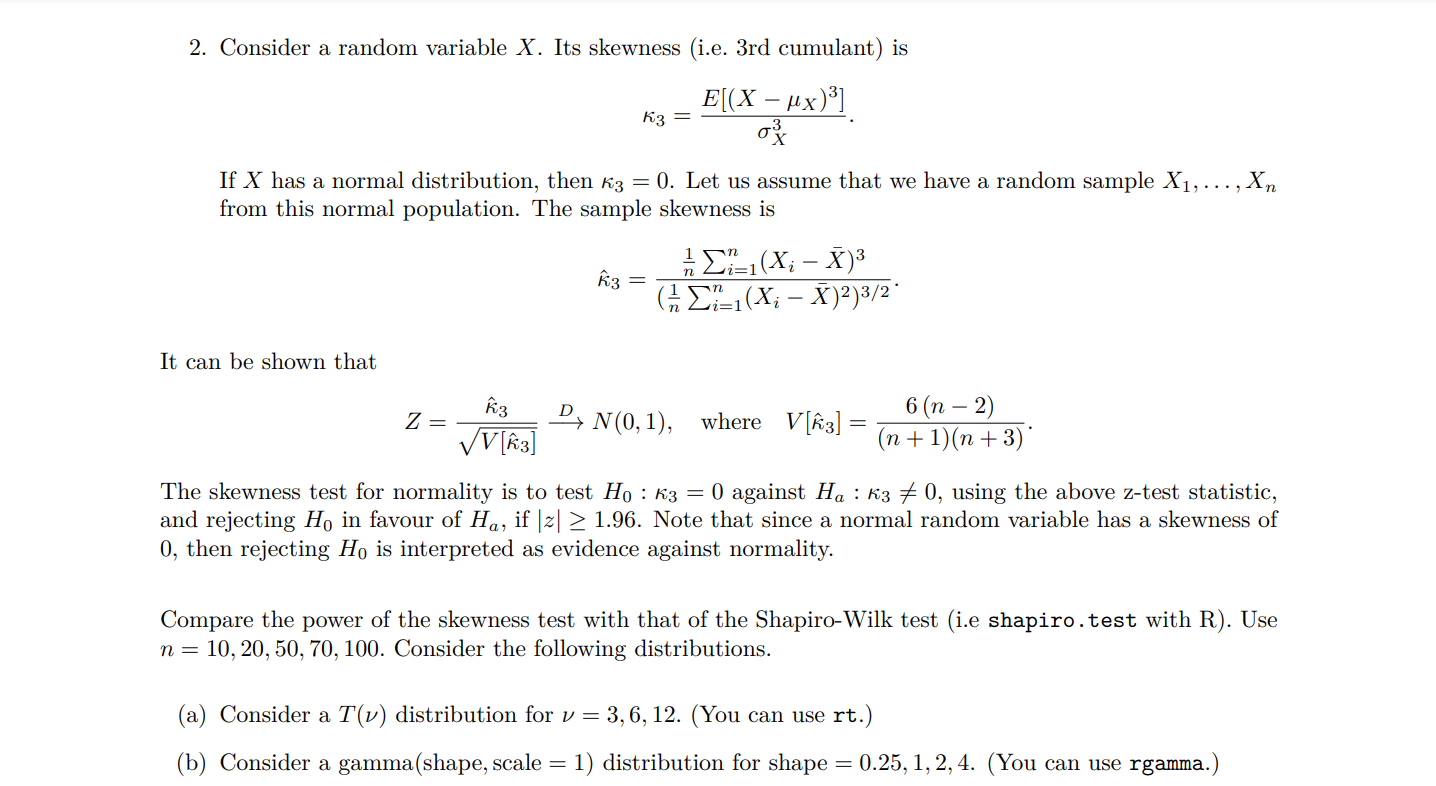
2. Consider a random variable X. Its skewness (i.e. 3rd cumulant) is E[(X-x)] If X has a normal distribution, then 30. Let us assume that we have a random sample X,..., Xn from this normal population. The sample skewness is R3 = ( - ) ( ( - )2)3/2 It can be shown that R3 z= D> N(0, 1), where V[3]= 6(n-2) (n+1)(n+3) V[3] The skewness test for normality is to test Ho and rejecting Ho in favour of Ha, if |2| 1.96. K3 = 0 against H K3 0, using the above z-test statistic, Note that since a normal random variable has a skewness of 0, then rejecting Ho is interpreted as evidence against normality. Compare the power of the skewness test with that of the Shapiro-Wilk test (i.e shapiro. test with R). Use n = 10, 20, 50, 70, 100. Consider the following distributions. (a) Consider a T() distribution for 3, 6, 12. (You can use rt.) (b) Consider a gamma(shape, scale = 1) distribution for shape = 0.25, 1, 2, 4. (You can use rgamma.)
Step by Step Solution
There are 3 Steps involved in it

Get step-by-step solutions from verified subject matter experts