







Question: 2. Consider a relation r(A, B, C, D) that has a clustering index on A and a non-clustering index on each of the other attributes.
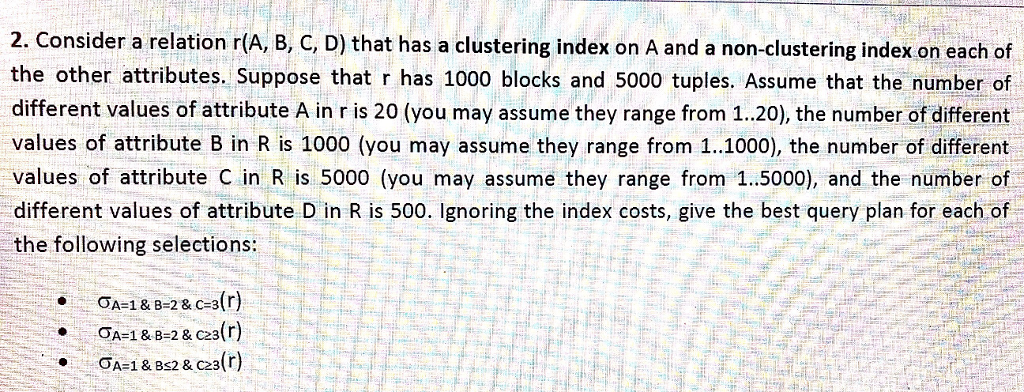
2. Consider a relation r(A, B, C, D) that has a clustering index on A and a non-clustering index on each of the other attributes. Suppose that r has 1000 blocks and 5000 tuples. Assume that the number of different values of attribute A in r is 20 (you may assume they range from 1..20), the number of different values of attribute B in R is 1000 (you may assume they range from 1..1000), the number of different values of attribute C in R is 5000 (you may assume they range from 1..5000), and the number of different values of attribute D in R is 500. Ignoring the index costs, give the best query plan for each of the following selections: 2. Consider a relation r(A, B, C, D) that has a clustering index on A and a non-clustering index on each of the other attributes. Suppose that r has 1000 blocks and 5000 tuples. Assume that the number of different values of attribute A in r is 20 (you may assume they range from 1..20), the number of different values of attribute B in R is 1000 (you may assume they range from 1..1000), the number of different values of attribute C in R is 5000 (you may assume they range from 1..5000), and the number of different values of attribute D in R is 500. Ignoring the index costs, give the best query plan for each of the following selections
Step by Step Solution
There are 3 Steps involved in it

Get step-by-step solutions from verified subject matter experts
 Study Help