







Question: 2- Consider a rod with length L = 4m and mass M = 14kg uniformly distributed. The rod is initially stationary but it is NOT
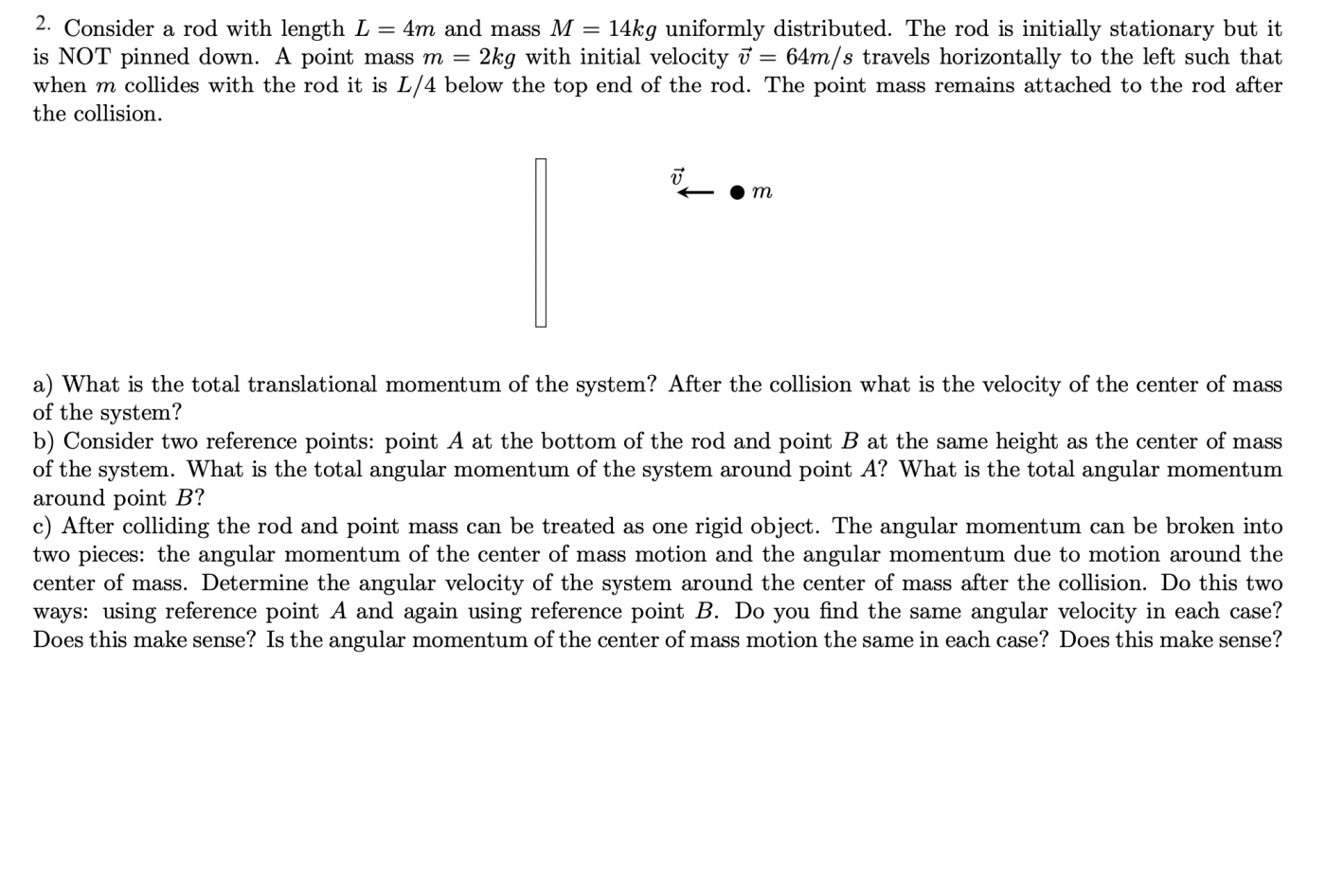
2- Consider a rod with length L = 4m and mass M = 14kg uniformly distributed. The rod is initially stationary but it is NOT pinned down. A point mass m = 2kg with initial velocity 17 = 64m/s travels horizontally to the left such that when m collides with the rod it is L/4 below the top end of the rod. The point mass remains attached to the rod after the collision. a) What is the total translational momentum of the system? After the collision what is the velocity of the center of mass of the system? b) Consider two reference points: point A at the bottom of the rod and point B at the same height as the center of mass of the system. What is the total angular momentum of the system around point A? What is the total angular momentum around point B? c) After colliding the rod and point mass can be treated as one rigid object. The angular momentum can be broken into two pieces: the angular momentum of the center of mass motion and the angular momentum due to motion around the center of mass. Determine the angular velocity of the system around the center of mass after the collision. Do this two ways: using reference point A and again using reference point B. Do you nd the same angular velocity in each case? Does this make sense? Is the angular momentum of the center of mass motion the same in each case? Does this make sense
Step by Step Solution
There are 3 Steps involved in it

Get step-by-step solutions from verified subject matter experts
 Study Help