





Question: 2. Consider a single server queue. Initially, there is no customer in the system. Suppose that the inter-arrival times of the first 15 customers are:
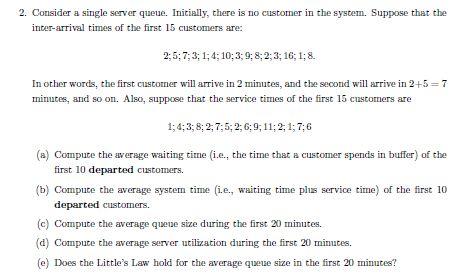
2. Consider a single server queue. Initially,

2. Consider a single server queue. Initially, there is no customer in the system. Suppose that the inter-arrival times of the first 15 customers are: 2:5:7; 3:1; 4; 10;3; 9; 8; 2; 3; 16; 1; 8. In other words, the first customer will arrive in 2 minutes, and the second will arrive in 2+5 = 7 minutes, and so on. Also, suppose that the service times of the first 15 customers are 1;4;3; 8:2, 7:5; 2; 6; 9; 11; 2; 1; 7;6 (a) Compute the average waiting time (i.e., the time that a customer spends in buffer) of the first 10 departed customers. (b) Compute the average system time (i.e., waiting time plus service time) of the first 10 departed customers. (c) Compute the average queue size during the first 20 minutes. (d) Compute the average server utilization during the first 20 minutes. (e) Does the Little's Law hold for the average queue size in the first 20 minutes

Step by Step Solution

There are 3 Steps involved in it

1 Expert Approved Answer
Step: 1 Unlock blur-text-image

Question Has Been Solved by an Expert!

Get step-by-step solutions from verified subject matter experts

Step: 2 Unlock
Step: 3 Unlock

Students Have Also Explored These Related General Management Questions!