







Question: 2. Consider a web client requesting a base html page of size O 5,000 bytes from a web server. This base html page contains 3
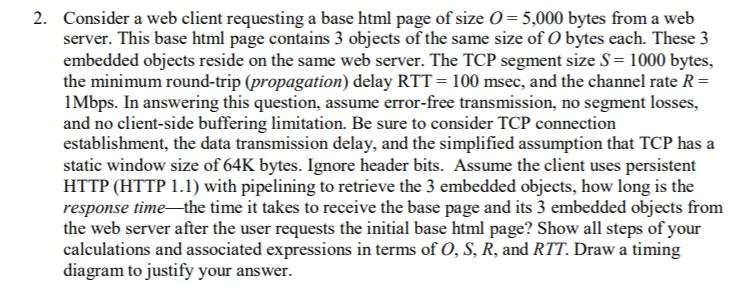
2. Consider a web client requesting a base html page of size O 5,000 bytes from a web server. This base html page contains 3 objects of the same size of O bytes each. These 3 embedded objects reside on the same web server. The TCP segment size S 1000 bytes, the minimum round-trip propagation) delay RTT = 100 msec, and the channel rate R 1Mbps. In answering this question, assume error-free transmission, no segment losses, and no client-side buffering limitation. Be sure to consider TCP connection establishment, the data transmission delay, and the simplified assumption that TCP has a static window size of 64K bytes. Ignore header bits. Assume the client uses persistent HTTP (HTTP 1.1) with pipelining to retrieve the 3 embedded objects, how long is the response time-the time it takes to receive the base page and its 3 embedded objects from the web server after the user requests the initial base html page? Show all steps of your calculations and associated expressions in terms of O, S, R, and RTT. Draw a timing diagram to justify your answer. 2. Consider a web client requesting a base html page of size O 5,000 bytes from a web server. This base html page contains 3 objects of the same size of O bytes each. These 3 embedded objects reside on the same web server. The TCP segment size S 1000 bytes, the minimum round-trip propagation) delay RTT = 100 msec, and the channel rate R 1Mbps. In answering this question, assume error-free transmission, no segment losses, and no client-side buffering limitation. Be sure to consider TCP connection establishment, the data transmission delay, and the simplified assumption that TCP has a static window size of 64K bytes. Ignore header bits. Assume the client uses persistent HTTP (HTTP 1.1) with pipelining to retrieve the 3 embedded objects, how long is the response time-the time it takes to receive the base page and its 3 embedded objects from the web server after the user requests the initial base html page? Show all steps of your calculations and associated expressions in terms of O, S, R, and RTT. Draw a timing diagram to justify your
Step by Step Solution
There are 3 Steps involved in it

Get step-by-step solutions from verified subject matter experts
 Study Help