







Question: 2. Consider an economy with .J countries producing ./ different cnuntryspecific goods, as in the Armington economy of lecture note 2. Consumers everywhere have the
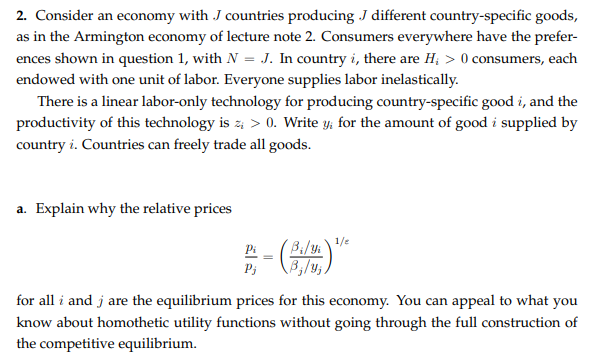
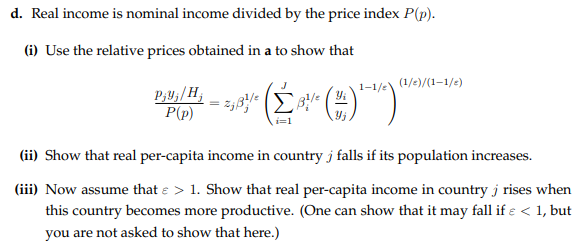
2. Consider an economy with .J countries producing ./ different cnuntryspecific goods, as in the Armington economy of lecture note 2. Consumers everywhere have the prefer- ences shown in question 1, with = .J. In country , there are H; > () consumers, each endowed with one unit of labor. Everyone supplies labor inelastically. There is a linear labor-only technology for producing country-specific good i, and the productivity of this technology is z; = 0. Write y, for the amount of good i supplied by country i. Countries can freely trade all goods. a. Explain why the relative prices n (-3, [y ) P 3,/ for all i and j are the equilibrium prices for this economy. You can appeal to what you know about homothetic utility functions without going through the full construction of the competitive equilibrium. d. Real income is nominal income divided by the price index P(p). (i) Use the relative prices obtained in a to show that ) J 1-1/= (1f=)/(1-1/=) Py H; e 3 ik (&) P(p) AT Ay (ii) Show that real per-capita income in country j falls if its population increases. (iii) Now assume that = > 1. Show that real per-capita income in country j rises when this country becomes more productive. (One can show that it may fall if =
Step by Step Solution
There are 3 Steps involved in it

Get step-by-step solutions from verified subject matter experts
 Study Help