



Question: 2. Consider an Item with the following properties: A = $ 20 v= $ 2/unit r=0.245/5/yr At time 0 the inventory has dropped to zero
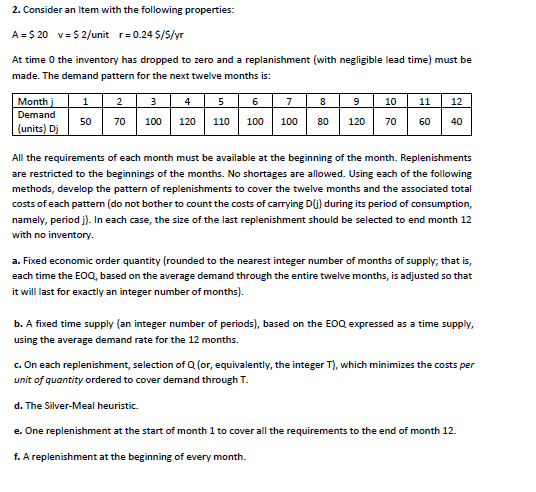
2. Consider an Item with the following properties: A = $ 20 v= $ 2/unit r=0.245/5/yr At time 0 the inventory has dropped to zero and a replanishment (with negligible lead time) must be made. The demand pattern for the next twelve months is: Month 1 2 3 | 4 | 5 | 6 | 7 | 8 9 10 11 12 Demand 50 70 100 120 110 100 100 80 120 70 60 40 (units) Dj All the requirements of each month must be available at the beginning of the month. Replenishments are restricted to the beginnings of the months. No shortages are allowed. Using each of the following methods, develop the pattern of replenishments to cover the twelve months and the associated total costs of each pattern (do not bother to count the costs of carrying Dlj) during its period of consumption, namely, periodj). In each case, the size of the last replenishment should be selected to end month 12 with no inventory. a. Fixed economic order quantity (rounded to the nearest integer number of months of supply; that is, each time the EOQ, based on the average demand through the entire twelve months, is adjusted so that it will last for exactly an integer number of months). b. A fixed time supply (an integer number of periods), based on the EOQ expressed as a time supply, using the average demand rate for the 12 months. c. On each replenishment, selection of Qlor, equivalently, the integer T), which minimizes the costs per unit of quantity ordered to cover demand through T. d. The Silver-Meal heuristic. e. One replenishment at the start of month 1 to cover all the requirements to the end of month 12. f. A replenishment at the beginning of every month. 2. Consider an Item with the following properties: A = $ 20 v= $ 2/unit r=0.245/5/yr At time 0 the inventory has dropped to zero and a replanishment (with negligible lead time) must be made. The demand pattern for the next twelve months is: Month 1 2 3 | 4 | 5 | 6 | 7 | 8 9 10 11 12 Demand 50 70 100 120 110 100 100 80 120 70 60 40 (units) Dj All the requirements of each month must be available at the beginning of the month. Replenishments are restricted to the beginnings of the months. No shortages are allowed. Using each of the following methods, develop the pattern of replenishments to cover the twelve months and the associated total costs of each pattern (do not bother to count the costs of carrying Dlj) during its period of consumption, namely, periodj). In each case, the size of the last replenishment should be selected to end month 12 with no inventory. a. Fixed economic order quantity (rounded to the nearest integer number of months of supply; that is, each time the EOQ, based on the average demand through the entire twelve months, is adjusted so that it will last for exactly an integer number of months). b. A fixed time supply (an integer number of periods), based on the EOQ expressed as a time supply, using the average demand rate for the 12 months. c. On each replenishment, selection of Qlor, equivalently, the integer T), which minimizes the costs per unit of quantity ordered to cover demand through T. d. The Silver-Meal heuristic. e. One replenishment at the start of month 1 to cover all the requirements to the end of month 12. f. A replenishment at the beginning of every month
Step by Step Solution
There are 3 Steps involved in it

Get step-by-step solutions from verified subject matter experts