







Question: 2. Consider f[:c,y) = (a) (b) (C) (d) y2_$2 2 Draw contour lines for f(a:,y) and g(u,v) in a single icy-plane and single av- plane
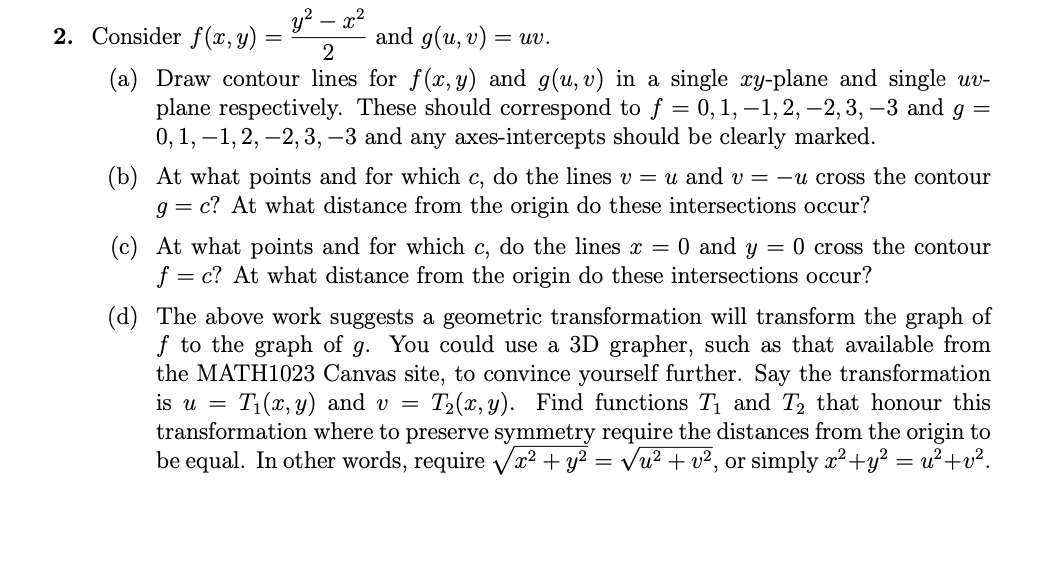
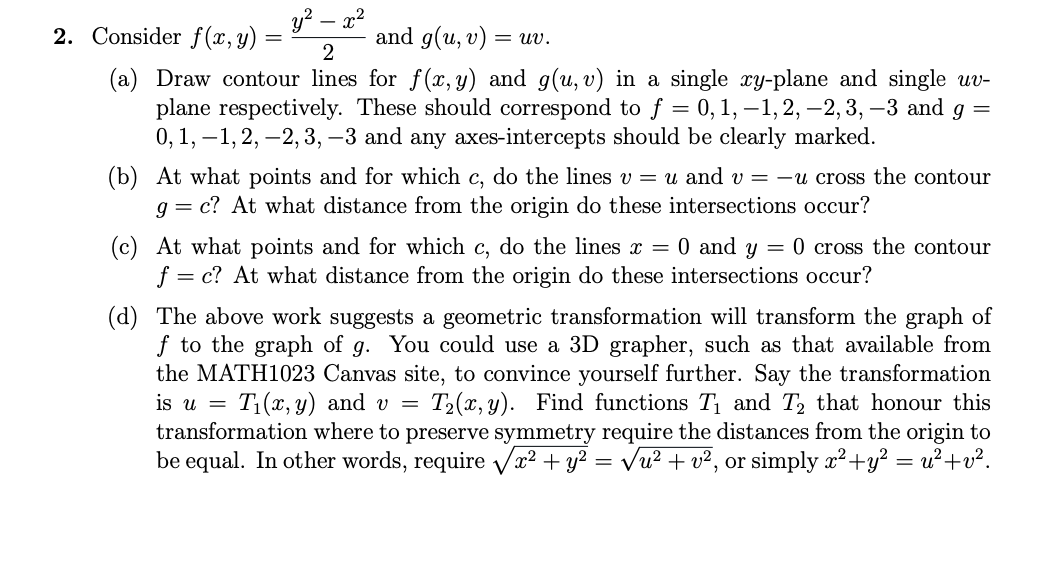
2. Consider f[:c,y) = (a) (b) (C) (d) y2_$2 2 Draw contour lines for f(a:,y) and g(u,v) in a single icy-plane and single av- plane respectively. These should correspond to f = 0, l, l,2, 2,3, 3 and g = 0, 1, 1, 2, 2, 3, 3 and any axes-intercepts should be clearly marked. and g(u, v) = us. At what points and for which c, do the lines o = a and 'U = u cross the contour g = c? At what distance from the origin do these intersections occur? At what points and for which c, do the lines 3: = 0 and y = 0 cross the contour f = c? At what distance from the origin do these intersections occur? The above work suggests a geometric transformation will transform the graph of f to the graph of 9. You could use a 3D grapher, such as that available from the MATH1023 Canvas site, to convince yourself further. Say the transformation is u : T1(:c,y) and v = T2(:c,y). Find functions T1 and T2 that honour this transformation where to preserve symmetry require the distances from the origin to be equal. In other words, require :32 + y2 2 Va? + 29, or simply 332+y2 = u2+v2
Step by Step Solution
There are 3 Steps involved in it

Get step-by-step solutions from verified subject matter experts
 Study Help