







Question: 2. Consider Table 1. Table 1 Firm Assets Debt Equity Cost of unlevered equity | Corporate tax rate (%) Personal tax rate Personal tax rate
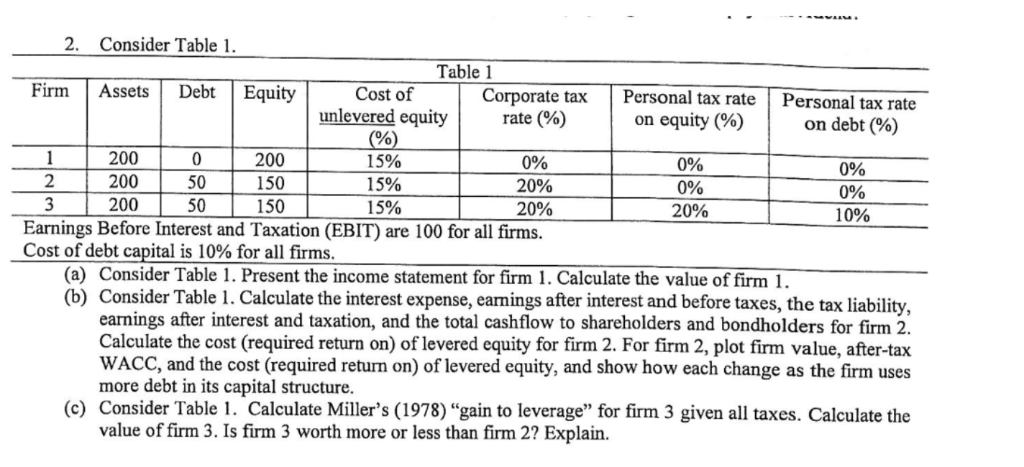
2. Consider Table 1. Table 1 Firm Assets Debt Equity Cost of unlevered equity | Corporate tax rate (%) Personal tax rate Personal tax rate on equity (%) on debt(%) 200 200 200 200 150 150 15% 1 5% 15% 0% 20% 20% 0% 0% 20% 0% 0% 10% 2 50 50 Earnings Before Interest and Taxation (EBIT) are 100 for all firms Cost of debt capital is 10% for all firms (a) Consider Table 1. Present the income statement for firm 1. Calculate the value of firm 1. (b) Consider Table 1. Calculate the interest expense, earnings after interest and before taxes, the tax liability, earnings after interest and taxation, and the total cashflow to shareholders and bondholders for firm 2. Calculate the cost (required return on) of levered equity for firm 2. For firm 2, plot firm value, after-tax WACC, and the cost (required returm on) of levered equity, and show how each change as the firm uses more debt in its capital structure (c) Consider Table 1. Calculate Miller's (1978) "gain to leverage" for firm 3 given all taxes. Calculate the value of firm 3. Is firm 3 worth more or less than firm 2? Explain. 2. Consider Table 1. Table 1 Firm Assets Debt Equity Cost of unlevered equity | Corporate tax rate (%) Personal tax rate Personal tax rate on equity (%) on debt(%) 200 200 200 200 150 150 15% 1 5% 15% 0% 20% 20% 0% 0% 20% 0% 0% 10% 2 50 50 Earnings Before Interest and Taxation (EBIT) are 100 for all firms Cost of debt capital is 10% for all firms (a) Consider Table 1. Present the income statement for firm 1. Calculate the value of firm 1. (b) Consider Table 1. Calculate the interest expense, earnings after interest and before taxes, the tax liability, earnings after interest and taxation, and the total cashflow to shareholders and bondholders for firm 2. Calculate the cost (required return on) of levered equity for firm 2. For firm 2, plot firm value, after-tax WACC, and the cost (required returm on) of levered equity, and show how each change as the firm uses more debt in its capital structure (c) Consider Table 1. Calculate Miller's (1978) "gain to leverage" for firm 3 given all taxes. Calculate the value of firm 3. Is firm 3 worth more or less than firm 2? Explain
Step by Step Solution
There are 3 Steps involved in it

Get step-by-step solutions from verified subject matter experts
 Study Help