


Question: 2. Consider that we have the following three time estimates for each of the tasks. Tasks Optimistic time (to) Pessimistic time (to) Most likely time
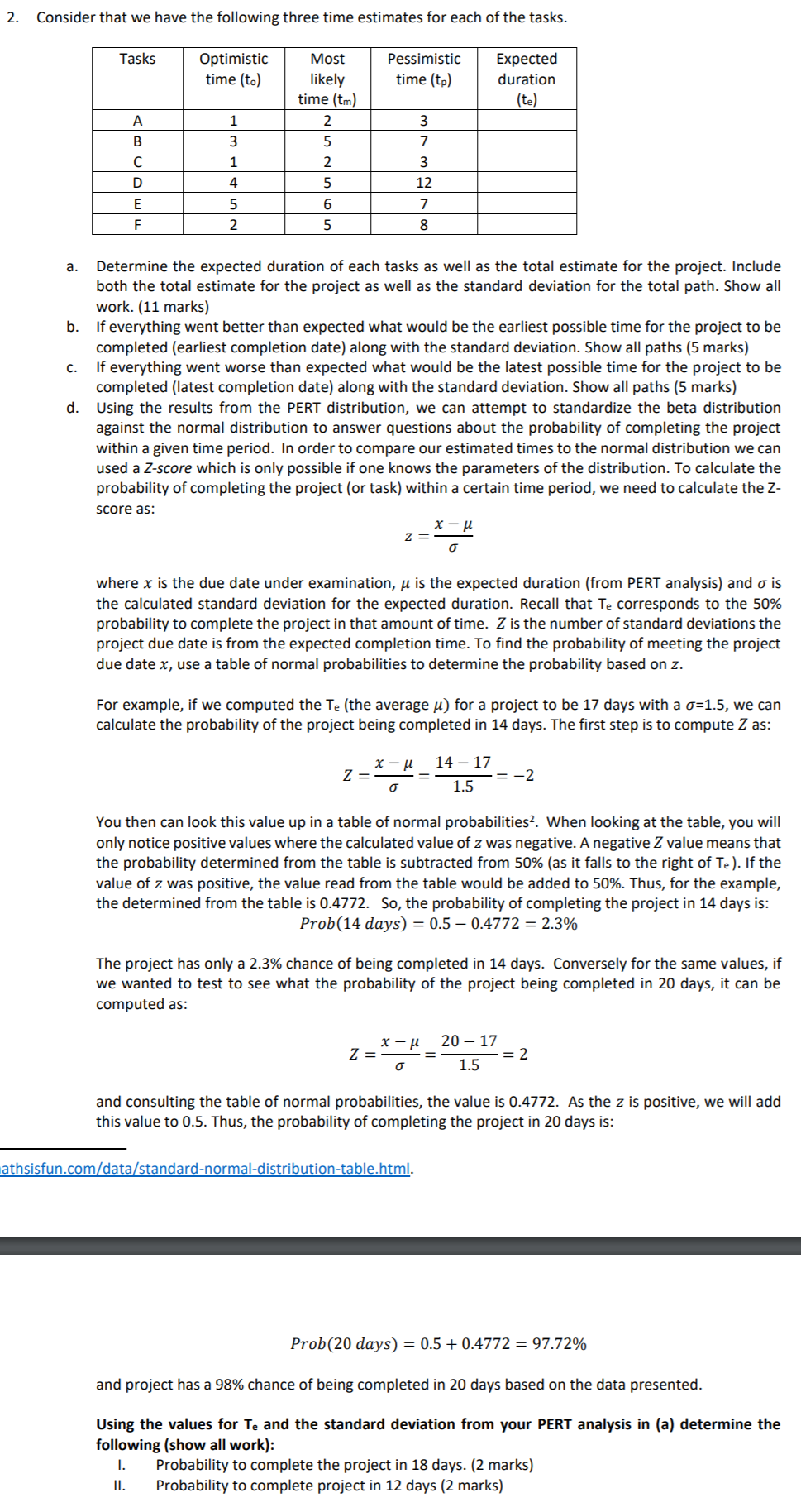
2. Consider that we have the following three time

2. Consider that we have the following three time estimates for each of the tasks. Tasks Optimistic time (to) Pessimistic time (to) Most likely time (tm) 2 Expected duration (te) A 1 3 7 B 3 5 1 3 D 4 2. 5 6 12 E 5 2 7 8 F 5 a. C. Determine the expected duration of each tasks as well as the total estimate for the project. Include both the total estimate for the project as well as the standard deviation for the total path. Show all work. (11 marks) b. If everything went better than expected what would be the earliest possible time for the project to be completed (earliest completion date) along with the standard deviation. Show all paths (5 marks) If everything went worse than expected what would be the latest possible time for the project to be completed (latest completion date) along with the standard deviation. Show all paths (5 marks) d. Using the results from the PERT distribution, we can attempt to standardize the beta distribution against the normal distribution to answer questions about the probability of completing the project within a given time period. In order to compare our estimated times to the normal distribution we can used a Z-score which is only possible if one knows the parameters of the distribution. To calculate the probability of completing the project (or task) within a certain time period, we need to calculate the Z- score as: - Z= o where x is the due date under examination, u is the expected duration (from PERT analysis) and o is the calculated standard deviation for the expected duration. Recall that Te corresponds to the 50% probability to complete the project in that amount of time. Z is the number of standard deviations the project due date is from the expected completion time. To find the probability of meeting the project due date x, use a table of normal probabilities to determine the probability based on z. For example, if we computed the Te (the average u) for a project to be 17 days with a o=1.5, we can calculate the probability of the project being completed in 14 days. The first step is to compute Z as: - Z= o 14 - 17 = -2 1.5 You then can look this value up in a table of normal probabilities. When looking at the table, you will only notice positive values where the calculated value of z was negative. A negative Z value means that the probability determined from the table is subtracted from 50% (as it falls to the right of Te). If the value of z was positive, the value read from the table would be added to 50%. Thus, for the example, the determined from the table is 0.4772. So, the probability of completing the project in 14 days is: Prob(14 days) = 0.5 -0.4772 = 2.3% The project has only a 2.3% chance of being completed in 14 days. Conversely for the same values, if we wanted to test to see what the probability of the project being completed in 20 days, it can be computed as: - 20 17 Z= = 2 0 1.5 and consulting the table of normal probabilities, the value is 0.4772. As the z is positive, we will add this value to 0.5. Thus, the probability of completing the project in 20 days is: athsisfun.com/data/standard-normal-distribution-table.html. Prob(20 days) = 0.5 + 0.4772 = 97.72% and project has a 98% chance of being completed in 20 days based on the data presented. Using the values for Te and the standard deviation from your PERT analysis in (a) determine the following (show all work): 1. Probability to complete the project in 18 days. (2 marks) II. Probability to complete project in 12 days (2 marks)

Step by Step Solution

There are 3 Steps involved in it

1 Expert Approved Answer
Step: 1 Unlock blur-text-image

Question Has Been Solved by an Expert!

Get step-by-step solutions from verified subject matter experts

Step: 2 Unlock
Step: 3 Unlock

Students Have Also Explored These Related General Management Questions!