







Question: Consider the AR(2) (1+ B)X; = Zt. where Xo = X1 = 0 and t = 1,2, 3, .... (i) Is Xt stationary? Why?
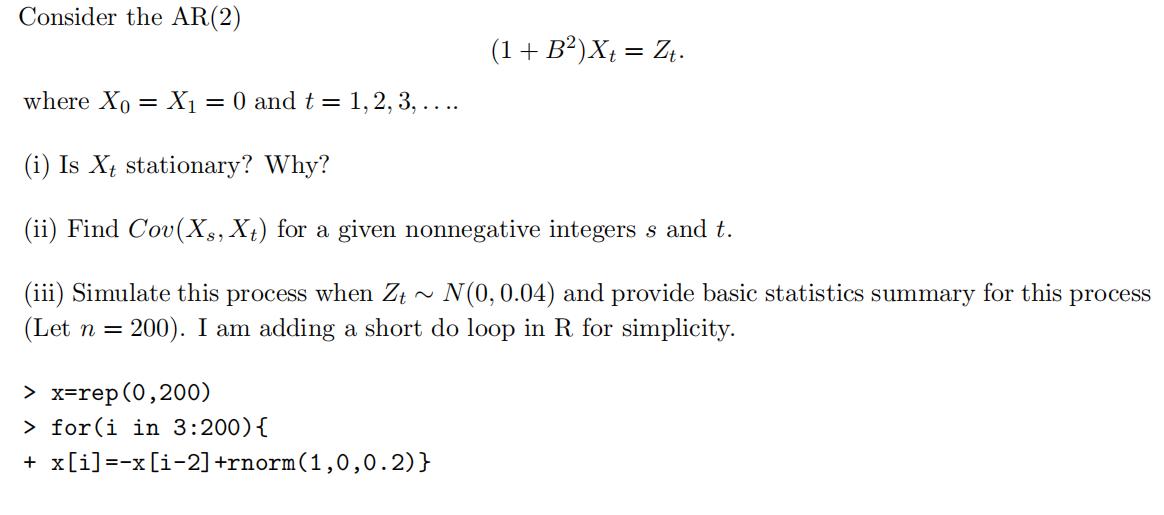
Consider the AR(2) (1+ B)X; = Zt. where Xo = X1 = 0 and t = 1,2, 3, .... (i) Is Xt stationary? Why? (ii) Find Cov(Xs, Xt) for a given nonnegative integers s and t. (iii) Simulate this process when Zt ~ N(0, 0.04) and provide basic statistics summary for this process (Let n = 200). I am adding a short do loop in R for simplicity. > x=rep (0,200) > for(i in 3:200){ + x[i]=-x [i-2] +rnorm(1,0,0.2)}
Step by Step Solution
★★★★★
3.48 Rating (164 Votes )
There are 3 Steps involved in it
1 Expert Approved Answer
Step: 1 Unlock

Given That Consider the AR2 1 BX Z Where Xo X1 0 and t 1 2 3 Given We are gi... View full answer
Question Has Been Solved by an Expert!
Get step-by-step solutions from verified subject matter experts
Step: 2 Unlock
Step: 3 Unlock
 Study Help