







Question: 2) Consider the following relation with sample data. - A student has a unique SID and a non-unique name. - A faculty member has a
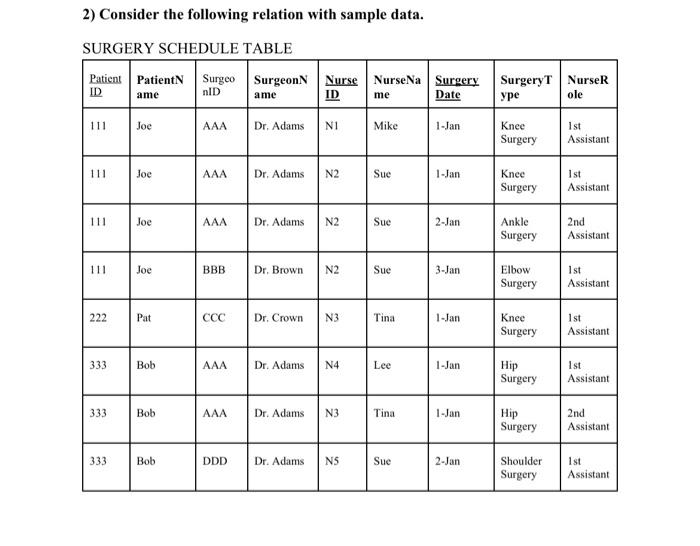
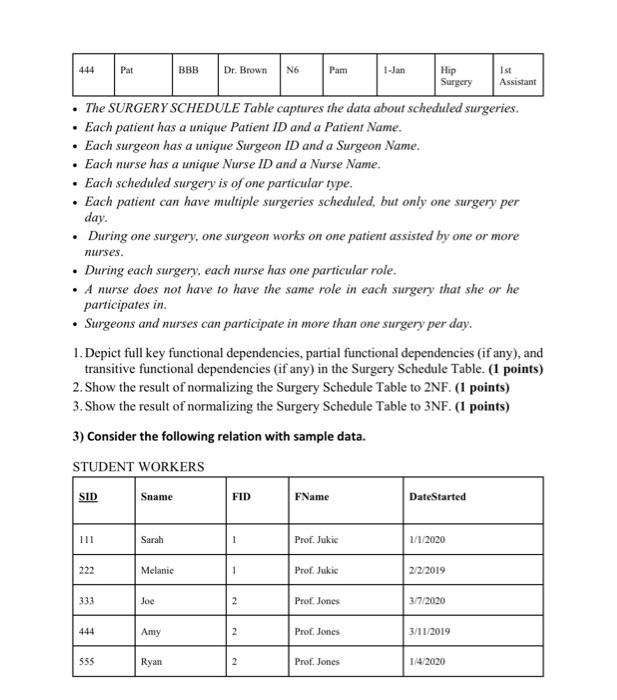
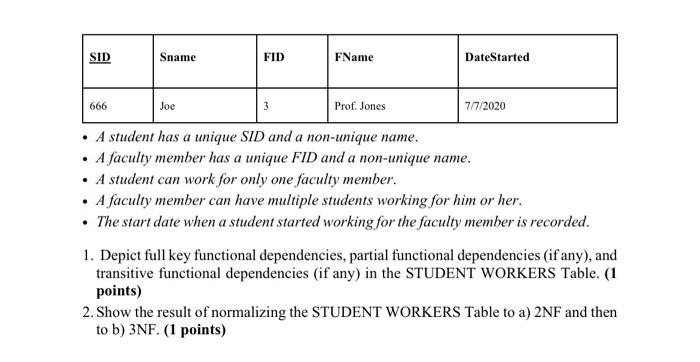
2) Consider the following relation with sample data. - A student has a unique SID and a non-unique name. - A faculty member has a unique FID and a non-unique name. - A student can work for only one faculty member. - A faculty member can have multiple students working for him or her. - The start date when a student started working for the faculty member is recorded. 1. Depict full key functional dependencies, partial functional dependencies (if any), and transitive functional dependencies (if any) in the STUDENT WORKERS Table. (1 points) 2. Show the result of normalizing the STUDENT WORKERS Table to a) 2 NF and then to b) 3 NF. (1 points) - The SURGERY SCHEDULE Table captures the data about scheduled surgeries. - Each patient has a unique Patient ID and a Patient Name. - Each surgeon has a unique Surgeon ID and a Surgeon Name. - Each nurse has a unique Nurse ID and a Nurse Name. - Each scheduled surgery is of one particular type. - Each patient can have multiple surgeries scheduled, but only one surgery per day. - During one surgery, one surgeon works on one patient assisted by one or more nurses. - During each surgery, each nurse has one particular role. - A nurse does not have to have the same role in each surgery that she or he participates in. - Surgeons and nurses can participate in more than one surgery per day. 1. Depict full key functional dependencies, partial functional dependencies (if any), and transitive functional dependencies (if any) in the Surgery Schedule Table. (1 points) 2. Show the result of normalizing the Surgery Schedule Table to 2 NF. (1 points) 3. Show the result of normalizing the Surgery Schedule Table to 3 NF. (1 points) 3) Consider the following relation with sample data
Step by Step Solution
There are 3 Steps involved in it

Get step-by-step solutions from verified subject matter experts
 Study Help