







Question: 2 Consider the function f (x) = x + 15x 3 (a) Find the domain of f (x). Note: Use the letter U for
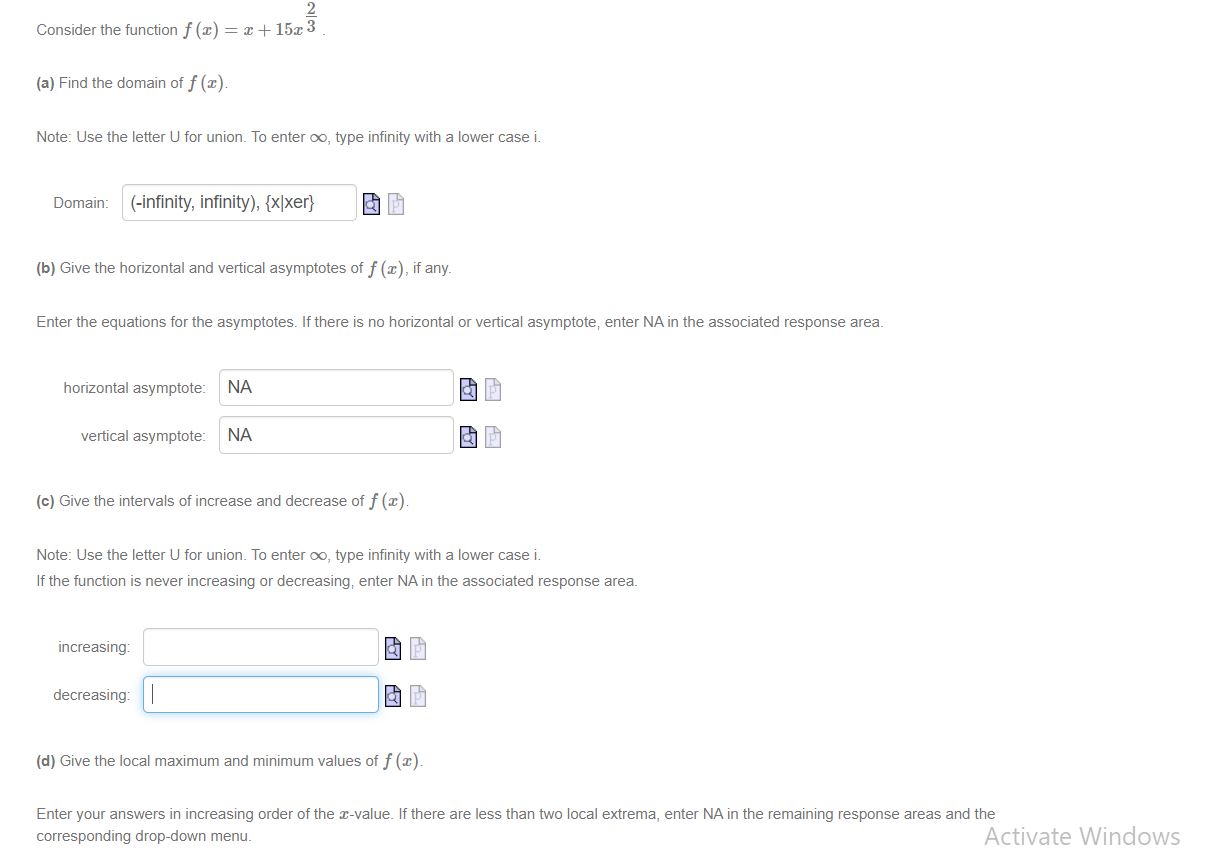
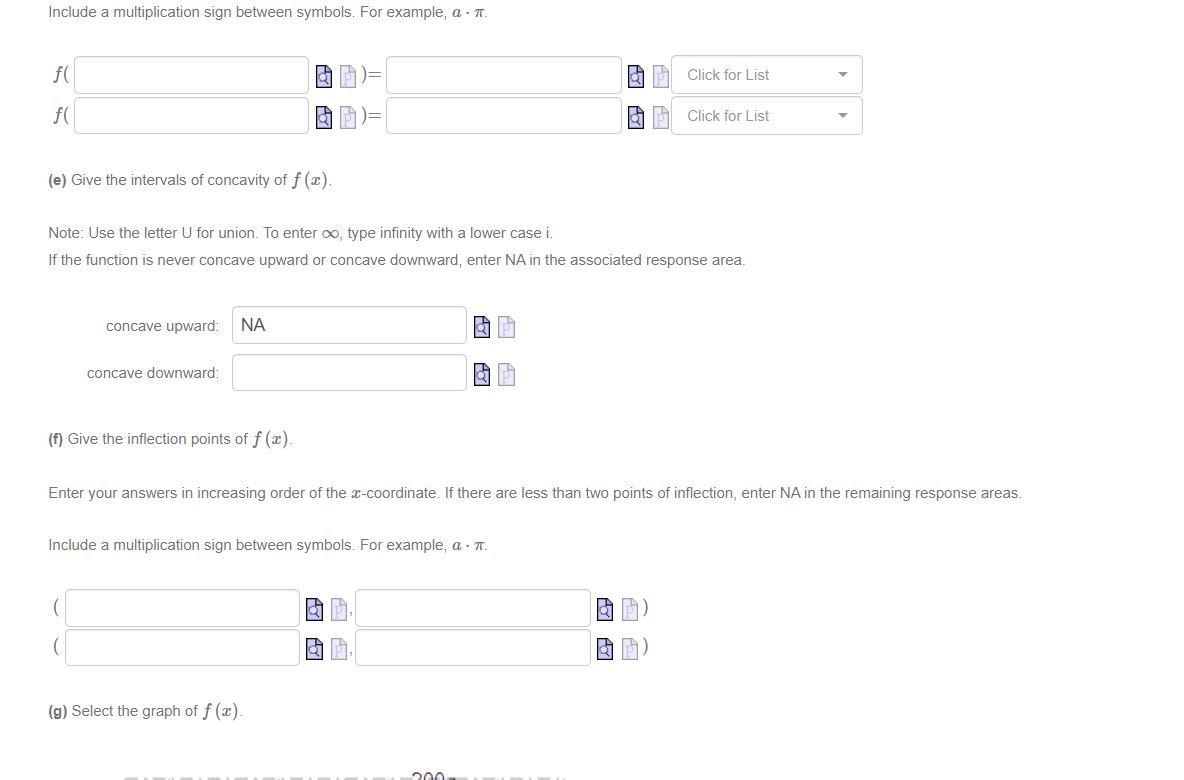
2 Consider the function f (x) = x + 15x 3 (a) Find the domain of f (x). Note: Use the letter U for union. To enter o, type infinity with a lower case i. Domain: (-infinity, infinity), {x|xer} (b) Give the horizontal and vertical asymptotes of f (x), if any. Enter the equations for the asymptotes. If there is no horizontal or vertical asymptote, enter NA in the associated response area. horizontal asymptote: vertical asymptote: ap (c) Give the intervals of increase and decrease of f(x). Note: Use the letter U for union. To enter o, type infinity with a lower case i. If the function is never increasing or decreasing, enter NA in the associated response area. increasing: decreasing: a a P (d) Give the local maximum and minimum values of f(x). Enter your answers in increasing order of the x-value. If there are less than two local extrema, enter NA in the remaining response areas and the corresponding drop-down menu. Activate Windows Include a multiplication sign between symbols. For example, a . . f( f( (e) Give the intervals of concavity of f (x). concave upward: concave downward: (f) Give the inflection points of f (x). &P= Note: Use the letter U for union. To enter o, type infinity with a lower case i. If the function is never concave upward or concave downward, enter NA in the associated response area. )= (g) Select the graph of f(x). & P & P BB Include a multiplication sign between symbols. For example, a . T. ap Enter your answers in increasing order of the x-coordinate. If there are less than two points of inflection, enter NA in the remaining response areas. 200 Click for List Click for List GP
Step by Step Solution
There are 3 Steps involved in it

Get step-by-step solutions from verified subject matter experts
 Study Help