







Question: 2. Consider the multiple mass-spring system shown in the figure below. We neglect the curvature so that each mass is pulled in opposite directions by
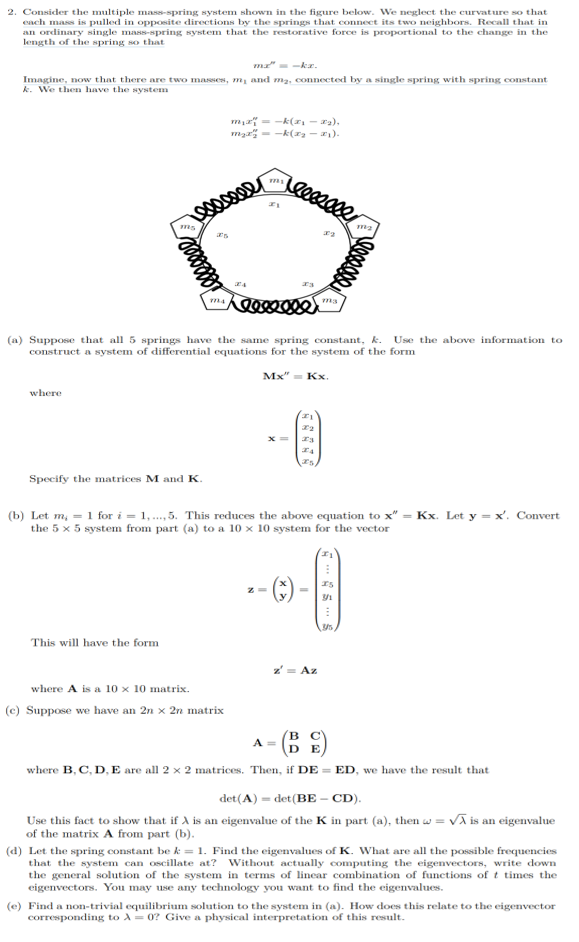
2. Consider the multiple mass-spring system shown in the figure below. We neglect the curvature so that each mass is pulled in opposite directions by the springs that connect its two neighbors. Recall that in an ordinary single mass-spring system that the restorative force is proportional to the change in the length of the spring so that Imagine, now that there are two masses, m, and m2, connected by a single spring with spring constant k. We then have the system mx = -f(x1 - *), mz-k(22-2. teszede 2 1000000 mencarece (a) Suppose that all 5 springs have the same spring constant, k. Use the above information to construct a system of differential equations for the system of the form Mx"Kx where Specify the matrices M and K (b) Let m; = 1 for i = 1, ...,5. This reduces the above equation to x" = Kx. Let y = x'. Convert the 5 x 5 system from part (a) to a 10 x 10 system for the vector Z US This will have the form z' = Az where A is a 10 x 10 matrix. (c) Suppose we have an 2n x 2n matrix B DE where B, C, D, E are all 2 x 2 matrices. Then, if DE = ED, we have the result that det(A) = det(BE - CD) Use this fact to show that if A is an eigenvalue of the K in part (a), then w = v is an eigenvalue of the matrix A from part (b). (a) Let the spring constant be k = 1. Find the eigenvalues of K. What are all the possible frequencies that the system can oscillate at? Without actually computing the eigenvectors, write down the general solution of the system in terms of linear combination of functions of t times the eigenvectors. You may use any technology you want to find the eigenvalues. (e) Find a non-trivial equilibrium solution to the system in (a). How does this relate to the eigenvector corresponding to X=0? Give a physical interpretation of this result. 2. Consider the multiple mass-spring system shown in the figure below. We neglect the curvature so that each mass is pulled in opposite directions by the springs that connect its two neighbors. Recall that in an ordinary single mass-spring system that the restorative force is proportional to the change in the length of the spring so that Imagine, now that there are two masses, m, and m2, connected by a single spring with spring constant k. We then have the system mx = -f(x1 - *), mz-k(22-2. teszede 2 1000000 mencarece (a) Suppose that all 5 springs have the same spring constant, k. Use the above information to construct a system of differential equations for the system of the form Mx"Kx where Specify the matrices M and K (b) Let m; = 1 for i = 1, ...,5. This reduces the above equation to x" = Kx. Let y = x'. Convert the 5 x 5 system from part (a) to a 10 x 10 system for the vector Z US This will have the form z' = Az where A is a 10 x 10 matrix. (c) Suppose we have an 2n x 2n matrix B DE where B, C, D, E are all 2 x 2 matrices. Then, if DE = ED, we have the result that det(A) = det(BE - CD) Use this fact to show that if A is an eigenvalue of the K in part (a), then w = v is an eigenvalue of the matrix A from part (b). (a) Let the spring constant be k = 1. Find the eigenvalues of K. What are all the possible frequencies that the system can oscillate at? Without actually computing the eigenvectors, write down the general solution of the system in terms of linear combination of functions of t times the eigenvectors. You may use any technology you want to find the eigenvalues. (e) Find a non-trivial equilibrium solution to the system in (a). How does this relate to the eigenvector corresponding to X=0? Give a physical interpretation of this result
Step by Step Solution
There are 3 Steps involved in it

Get step-by-step solutions from verified subject matter experts
 Study Help