



Question: 2. Consider the network shown in Figure 5.18: there is an edge between each pair of nodes, with five of the edges corresponding to positive
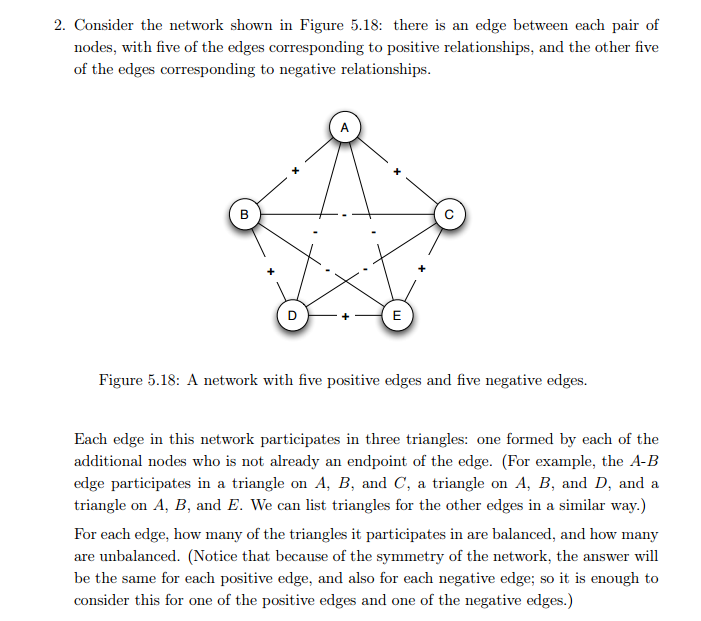
2. Consider the network shown in Figure 5.18: there is an edge between each pair of nodes, with five of the edges corresponding to positive relationships, and the other five of the edges corresponding to negative relationships Figure 5.18: A network with five positive edges and five negative edges. Each edge in this network participates in three triangles: one formed by each of the additional nodes who is not already an endpoint of the edge. (For example, the A-B edge participates in a triangle on A, B, and C, a triangle on A, B, and D, and a triangle on A, B, and E. We can list triangles for the other edges in a similar way.) For each edge, how many of the triangles it participates in are balanced, and how many are unbalanced. (Notice that because of the symmetry of the network, the answer will be the same for each positive edge, and also for each negative edge; so it is enough to consider this for one of the positive edges and one of the negative edges.)
Step by Step Solution
There are 3 Steps involved in it

Get step-by-step solutions from verified subject matter experts