Question: 2. Consider the ordinary transportation problem where we have: m source facilities with periodic capacity si, i = 1,...,m. n destination facilities with periodic demand
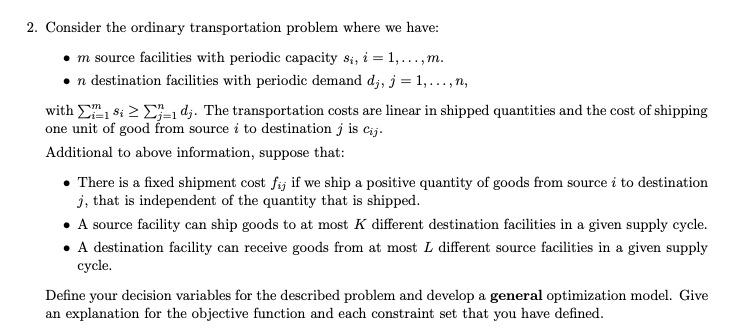
2. Consider the ordinary transportation problem where we have: m source facilities with periodic capacity si, i = 1,...,m. n destination facilities with periodic demand dj, j = 1,...,n, with 2 si 2 %;=1 d;. The transportation costs are linear in shipped quantities and the cost of shipping one unit of good from source i to destination j is Cije Additional to above information, suppose that: There is a fixed shipment cost fij if we ship a positive quantity of goods from source i to destination j, that is independent of the quantity that is shipped. A source facility can ship goods to at most K different destination facilities in a given supply cycle. A destination facility can receive goods from at most L different source facilities in a given supply cycle. Define your decision variables for the described problem and develop a general optimization model. Give an explanation for the objective function and each constraint set that you have defined. 2. Consider the ordinary transportation problem where we have: m source facilities with periodic capacity si, i = 1,...,m. n destination facilities with periodic demand dj, j = 1,...,n, with 2 si 2 %;=1 d;. The transportation costs are linear in shipped quantities and the cost of shipping one unit of good from source i to destination j is Cije Additional to above information, suppose that: There is a fixed shipment cost fij if we ship a positive quantity of goods from source i to destination j, that is independent of the quantity that is shipped. A source facility can ship goods to at most K different destination facilities in a given supply cycle. A destination facility can receive goods from at most L different source facilities in a given supply cycle. Define your decision variables for the described problem and develop a general optimization model. Give an explanation for the objective function and each constraint set that you have defined




