







Question: 2. Consider the partition problem: given n unique positive integers, partition them into two disjoint subsets (i.e., each number must be in exactly one subset
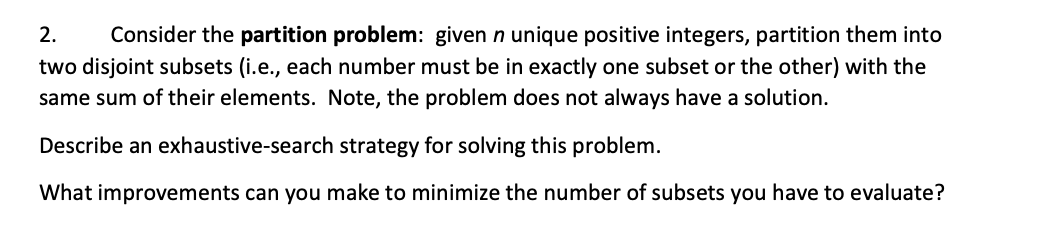
2. Consider the partition problem: given n unique positive integers, partition them into two disjoint subsets (i.e., each number must be in exactly one subset or the other) with the same sum of their elements. Note, the problem does not always have a solution. Describe an exhaustive-search strategy for solving this problem. What improvements can you make to minimize the number of subsets you have to evaluate? 2. Consider the partition problem: given n unique positive integers, partition them into two disjoint subsets (i.e., each number must be in exactly one subset or the other) with the same sum of their elements. Note, the problem does not always have a solution. Describe an exhaustive-search strategy for solving this problem. What improvements can you make to minimize the number of subsets you have to evaluate
Step by Step Solution
There are 3 Steps involved in it

Get step-by-step solutions from verified subject matter experts
 Study Help