







Question: 2) Consider the polynomial -in a single variable x-whose operations include the following degree0) coefficient(power) chageCoefficient newCoefficient, power)/Replaces the coefficient of the xewer term with
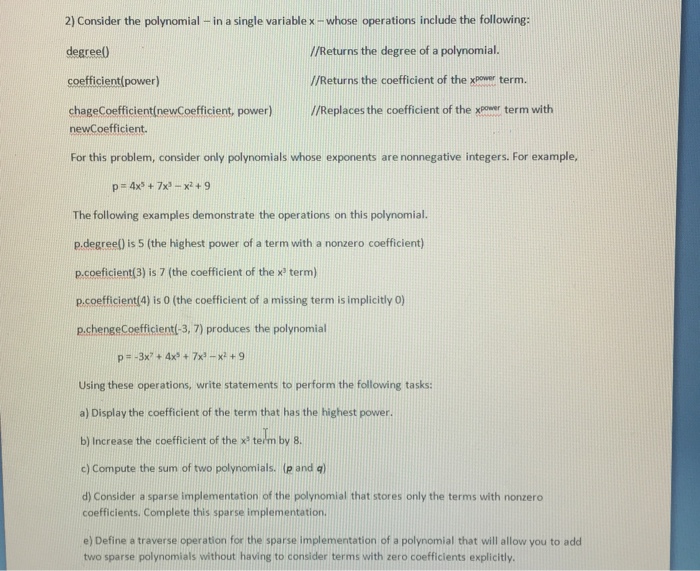
2) Consider the polynomial -in a single variable x-whose operations include the following degree0) coefficient(power) chageCoefficient newCoefficient, power)/Replaces the coefficient of the xewer term with newCoefficient. For this problem, consider only polynomials whose exponents are nonnegative integers. For example, //Returns the degree of a polynomial. //Returns the coefficient of the xpowr term. The following examples demonstrate the operations on this polynomial. p.degree) is 5 (the highest power of a term with a nonzero coefficient) p.coeficient(3) is 7 (the coefficient of the x) term) p.coefficient(4) is 0 (the coefficient of a missing term is implicitly O) p.chengeCoefficientl-3, 7) produces the polynomial Using these operations, write statements to perform the following tasks: a) Display the coefficient of the term that has the highest power. b) Increase the coefficient of the x3 te c) Compute the sum of two polynomials. (p and q) d) Consider a sparse implementation of the polynomial that stores only the terms with nonzero m by s. coefficients. Complete this sparse implementation. e) Define a traverse operation for the sparse implementation of a polynomial that will allow you to add two sparse polynomials without having to consider terms with zero coefficients explicitly
Step by Step Solution
There are 3 Steps involved in it

Get step-by-step solutions from verified subject matter experts
 Study Help