



Question: 2. Consider the prisoner's dilemma with payoffs as given below: g>0,>0 Suppose that the game is repeated twice, with the following twist. If a player
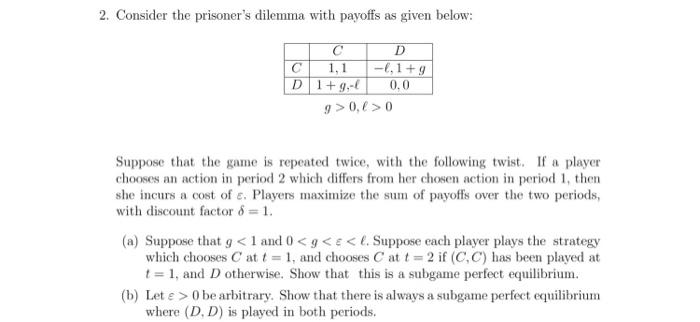
2. Consider the prisoner's dilemma with payoffs as given below: g>0,>0 Suppose that the game is repeated twice, with the following twist. If a player chooses an action in period 2 which differs from her chosen action in period 1, then she incurs a cost of . Players maximize the sum of payoffs over the two periods, with discount factor =1. (a) Suppose that g0 be arbitrary. Show that there is always a subgame perfect equilibrium where (D,D) is played in both periods. 2. Consider the prisoner's dilemma with payoffs as given below: g>0,>0 Suppose that the game is repeated twice, with the following twist. If a player chooses an action in period 2 which differs from her chosen action in period 1, then she incurs a cost of . Players maximize the sum of payoffs over the two periods, with discount factor =1. (a) Suppose that g0 be arbitrary. Show that there is always a subgame perfect equilibrium where (D,D) is played in both periods
Step by Step Solution
There are 3 Steps involved in it

Get step-by-step solutions from verified subject matter experts