







Question: 2. Consider the sequence k = 1+ (0.9), k = 0,1,2,.... This sequence converges to 1 at a q-linearly rate. (a) Approximately how may iterations
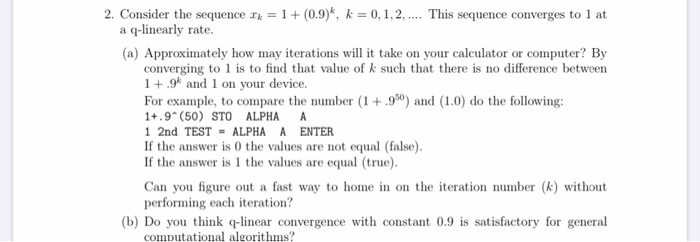
2. Consider the sequence k = 1+ (0.9)", k = 0,1,2,.... This sequence converges to 1 at a q-linearly rate. (a) Approximately how may iterations will it take on your calculator or computer? By converging to 1 is to find that value of k such that there is no difference between 1+.9% and 1 on your device. For example, to compare the number (1+.96') and (1.0) do the following: 1+.9 (50) STO ALPHA A 1 2nd TEST = ALPHA A ENTER If the answer is the values are not equal (false). If the answer is 1 the values are equal (true). Can you figure out a fast way to home in on the iteration number (k) without performing each iteration? (b) Do you think q-linear convergence with constant 0.9 is satisfactory for general computational algorithms? 2. Consider the sequence k = 1+ (0.9)", k = 0,1,2,.... This sequence converges to 1 at a q-linearly rate. (a) Approximately how may iterations will it take on your calculator or computer? By converging to 1 is to find that value of k such that there is no difference between 1+.9% and 1 on your device. For example, to compare the number (1+.96') and (1.0) do the following: 1+.9 (50) STO ALPHA A 1 2nd TEST = ALPHA A ENTER If the answer is the values are not equal (false). If the answer is 1 the values are equal (true). Can you figure out a fast way to home in on the iteration number (k) without performing each iteration? (b) Do you think q-linear convergence with constant 0.9 is satisfactory for general computational algorithms
Step by Step Solution
There are 3 Steps involved in it

Get step-by-step solutions from verified subject matter experts
 Study Help