







Question: 2. Consider the tournament whose adjacency matrix is 0 1 1 1 1 001 0 0 1 1 1 0 1 0 0 0 1
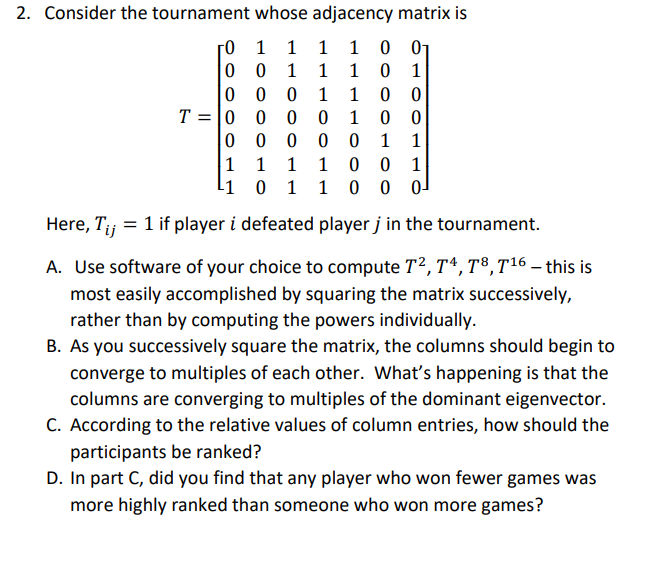
2. Consider the tournament whose adjacency matrix is 0 1 1 1 1 001 0 0 1 1 1 0 1 0 0 0 1 1 0 0 T = 100 0 0 1 0 0 0 0 0 0 0 1 1 1 1 1 1 0 0 1 11 0 o i i o] Here, Tij = 1 if player i defeated player j in the tournament. A. Use software of your choice to compute T2, T4, T8, T16 - this is most easily accomplished by squaring the matrix successively, rather than by computing the powers individually. B. As you successively square the matrix, the columns should begin to converge to multiples of each other. What's happening is that the columns are converging to multiples of the dominant eigenvector. C. According to the relative values of column entries, how should the participants be ranked? D. In part C, did you find that any player who won fewer games was more highly ranked than someone who won more games? 2. Consider the tournament whose adjacency matrix is 0 1 1 1 1 001 0 0 1 1 1 0 1 0 0 0 1 1 0 0 T = 100 0 0 1 0 0 0 0 0 0 0 1 1 1 1 1 1 0 0 1 11 0 o i i o] Here, Tij = 1 if player i defeated player j in the tournament. A. Use software of your choice to compute T2, T4, T8, T16 - this is most easily accomplished by squaring the matrix successively, rather than by computing the powers individually. B. As you successively square the matrix, the columns should begin to converge to multiples of each other. What's happening is that the columns are converging to multiples of the dominant eigenvector. C. According to the relative values of column entries, how should the participants be ranked? D. In part C, did you find that any player who won fewer games was more highly ranked than someone who won more games
Step by Step Solution
There are 3 Steps involved in it

Get step-by-step solutions from verified subject matter experts
 Study Help