







Question: 2. Create new functions that: a. Create a function takes four float output parameters (pass-by-reference): xl, yl, x2, y2, and one pass-by-value float parameter k.
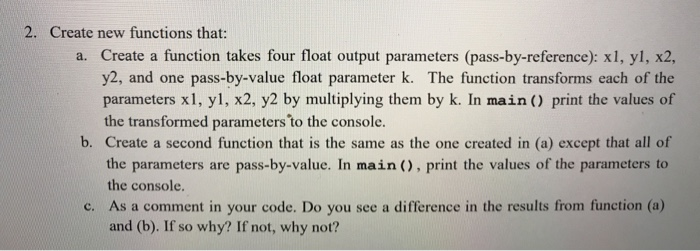
2. Create new functions that: a. Create a function takes four float output parameters (pass-by-reference): xl, yl, x2, y2, and one pass-by-value float parameter k. The function transforms each of the parameters x1, yl, x2, y2 by multiplying them by k. In main() print the values of the transformed parameters to the console. b. Create a second function that is the same as the one created in (a) except that all of the parameters are pass-by-value. In main(), print the values of the parameters to the console. c. As a comment in your code. Do you see a difference in the results from function (a) and (b). If so why? If not, why not
Step by Step Solution
There are 3 Steps involved in it

Get step-by-step solutions from verified subject matter experts
 Study Help