







Question: 2. Data Conversion. Please show the steps for each question and do not only write an answer without any steps. (1) Convert the binary number
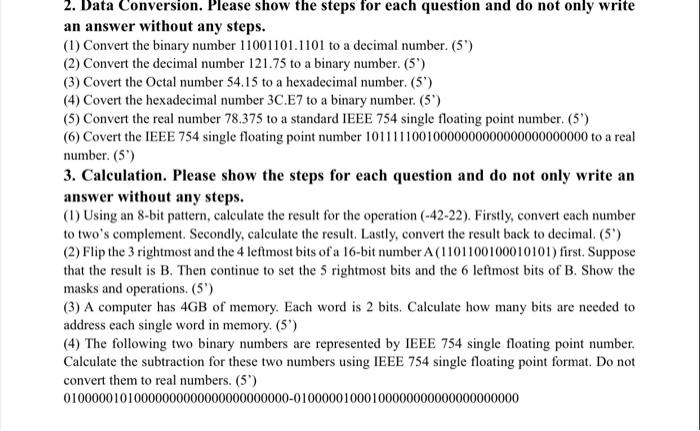
2. Data Conversion. Please show the steps for each question and do not only write an answer without any steps. (1) Convert the binary number 11001101.1101 to a decimal number. (5) (2) Convert the decimal number 121.75 to a binary number. (5') (3) Covert the Octal number 54.15 to a hexadecimal number. (5') (4) Covert the hexadecimal number 3C.E7 to a binary number. (5) (5) Convert the real number 78.375 to a standard IEEE 754 single floating point number. (5) (6) Covert the IEEE 754 single floating point number 10111110010000000000000000000000 to a real number. (5) 3. Calculation. Please show the steps for each question and do not only write an answer without any steps. (1) Using an 8-bit pattern, calculate the result for the operation (-42-22). Firstly, convert each number to two's complement. Secondly, calculate the result. Lastly, convert the result back to decimal. (5') (2) Flip the 3 rightmost and the 4 leftmost bits of a 16-bit number A(1101100100010101) first. Suppose that the result is B. Then continue to set the 5 rightmost bits and the 6 leftmost bits of B. Show the masks and operations. (5') (3) A computer has 4GB of memory. Each word is 2 bits. Calculate how many bits are needed to address each single word in memory. (5') (4) The following two binary numbers are represented by IEEE 754 single floating point number. Calculate the subtraction for these two numbers using IEEE 754 single floating point format. Do not convert them to real numbers. (5) 01000001010000000000000000000000-01000001000100000000000000000000
Step by Step Solution
There are 3 Steps involved in it

Get step-by-step solutions from verified subject matter experts
 Study Help