







Question: 2. {Day 1) In class we calculated the partition function for a quantum mechanical harmonic oscillator (Jfjr'iw/2 Qvib = m: where w is the angular
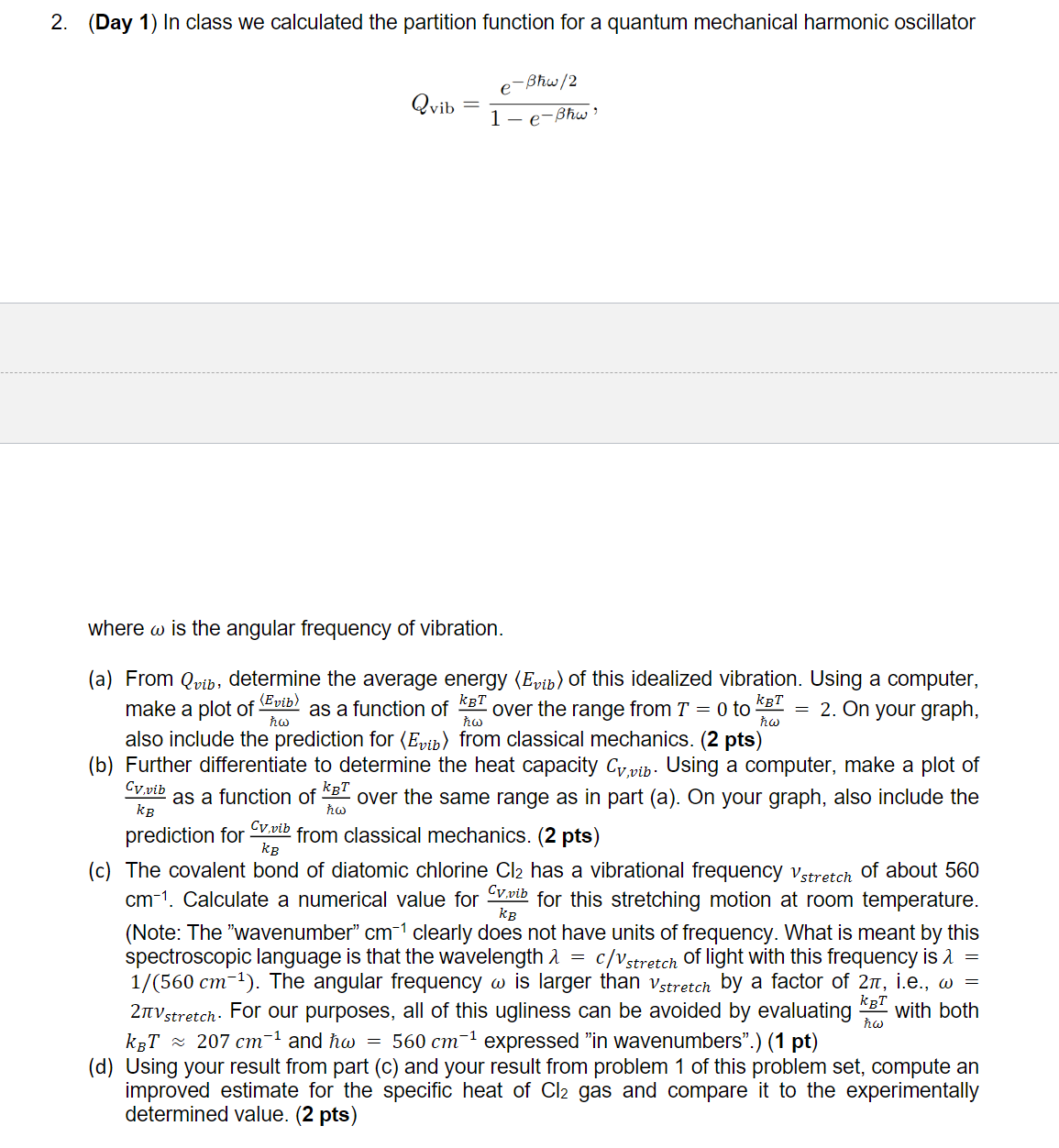
2. {Day 1) In class we calculated the partition function for a quantum mechanical harmonic oscillator (Jfjr'iw/2 Qvib = m: where w is the angular frequency of vibration. (at (b) (C) (d) From vab, determine the average energy (Em) of this idealized vibration. Using a computer, make a plot of (if) as a function of % over the range from T = 0 to \"in = 2. On your graph, hm also include the prediction for (Em) from classical mechanics. (2 pts) Further differentiate to determine the heat capacity Cmib. Using a computer, make a plot of C . . k \"'1' as a function of RS 5: over the same range as in part (a). On your graph, also include the prediction for C?\" from classical mechanics. {2 pts) 3 The covalent bond of diatomic chlorine CI2 has a vibrational frequency vstretch of about 560 . C - . . . cm\". Calculate a numerical value for '32\" for this stretching motion at room temperature. 3 (Note: The "wavenumber" cm'1 clearly does not have units of frequency. What is meant by this spectroscopiclanguageisthatthe wavelength ii = c/vmm oflight with this frequency is/i = 1/(560 (Tm1). The angular frequency w is larger than vsmm, by a factor of 21:, Le, a) = 2Hv5tmtch. For our purposes, all of this ugliness can be avoided by evaluating % with both k3?\" 2: 207 cm'1 and fun 2 560 syn1 expressed "in wavenumbers".) (1 pt) Using your result from part (c) and your result from problem 1 of this problem set, compute an improved estimate for the specic heat of Cl2 gas and compare it to the experimentally determined value. (2 pts)
Step by Step Solution
There are 3 Steps involved in it

Get step-by-step solutions from verified subject matter experts
 Study Help