







Question: 2. Definitions. Let n, k be non-negative integers with n2 k When n > 0, then the factorial of n (denote n!) is defined as
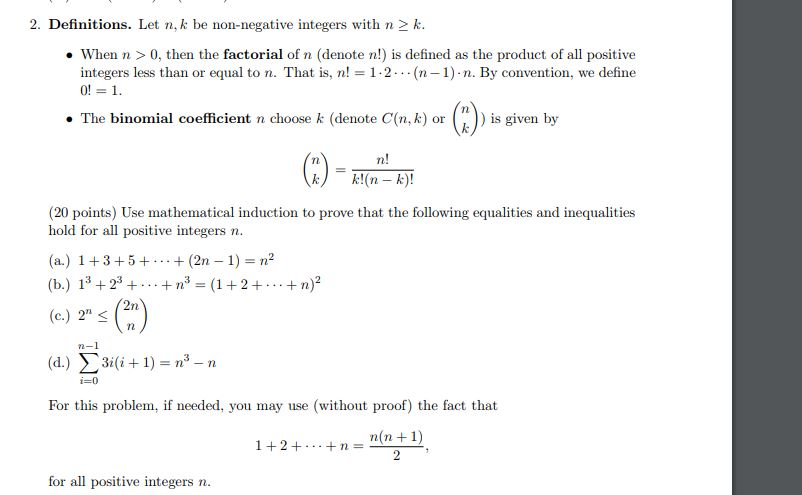
2. Definitions. Let n, k be non-negative integers with n2 k When n > 0, then the factorial of n (denote n!) is defined as the product of all positive integers less than or equal to n. That is, n! 1.2-in-1). n. By convention, we define . The binomial coefficient n choose k (denote C(n, k) or is given by rl n! (20 points) Use mathematical induction to prove that the following equalities and inequalities hold for all positive integers n (a.) 135(2n 1) n2 (b.) 1323 (12+ n)2 (c.) 2 rt (d) 3i(i + 1) n-n For this problem, if needed, you may use (without proof) the fact that n(n 1) for all positive integers n
Step by Step Solution
There are 3 Steps involved in it
1 Expert Approved Answer
Step: 1 Unlock

Question Has Been Solved by an Expert!
Get step-by-step solutions from verified subject matter experts
Step: 2 Unlock
Step: 3 Unlock
 Study Help