







Question: 2. Difference between i) Static and dynamic resistances of a p - n diode. ii) Transition and Diffusion capacitances of a p - n
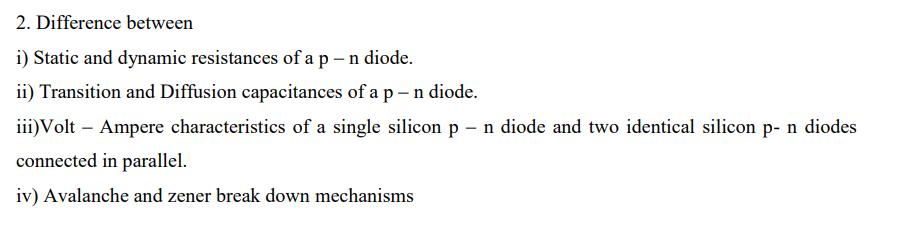
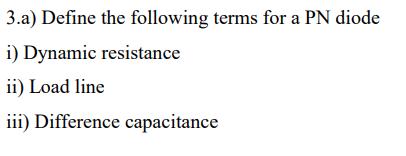
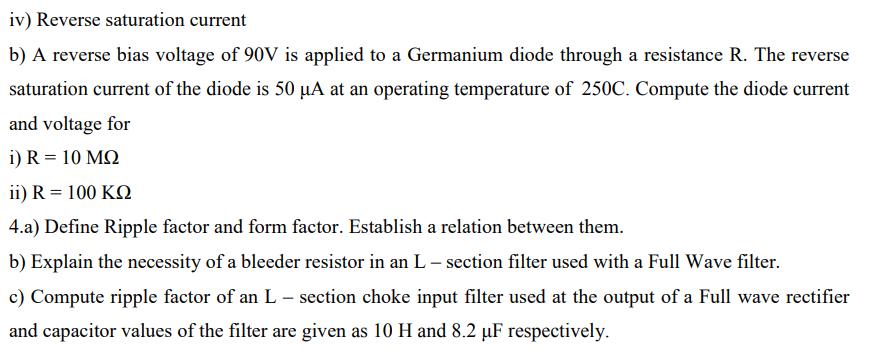
2. Difference between i) Static and dynamic resistances of a p - n diode. ii) Transition and Diffusion capacitances of a p - n diode. iii)Volt - Ampere characteristics of a single silicon pn diode and two identical silicon p- n diodes connected in parallel. iv) Avalanche and zener break down mechanisms 3.a) Define the following terms for a PN diode i) Dynamic resistance ii) Load line iii) Difference capacitance iv) Reverse saturation current b) A reverse bias voltage of 90V is applied to a Germanium diode through a resistance R. The reverse saturation current of the diode is 50 A at an operating temperature of 250C. Compute the diode current and voltage for i) R = 10 MQ ii) R = 100 KQ 4.a) Define Ripple factor and form factor. Establish a relation between them. b) Explain the necessity of a bleeder resistor in an L-section filter used with a Full Wave filter. c) Compute ripple factor of an L - section choke input filter used at the output of a Full wave rectifier and capacitor values of the filter are given as 10 H and 8.2 uF respectively.
Step by Step Solution
There are 3 Steps involved in it

Get step-by-step solutions from verified subject matter experts
 Study Help