



Question: 2. Discuss some ways that P&Gs CBD structure is more effec tive than a single sales For decades, Procter & Gamble has been at the
2. Discuss some ways that P&Gs CBD structure is more effec tive than a single sales
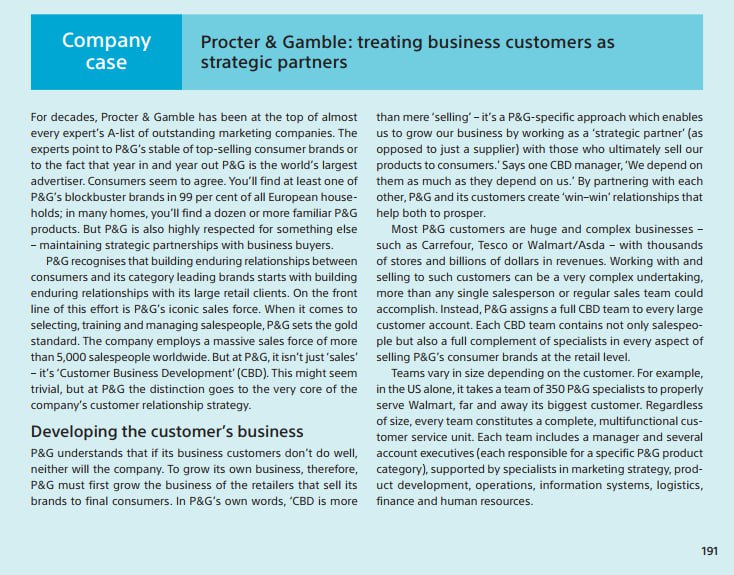
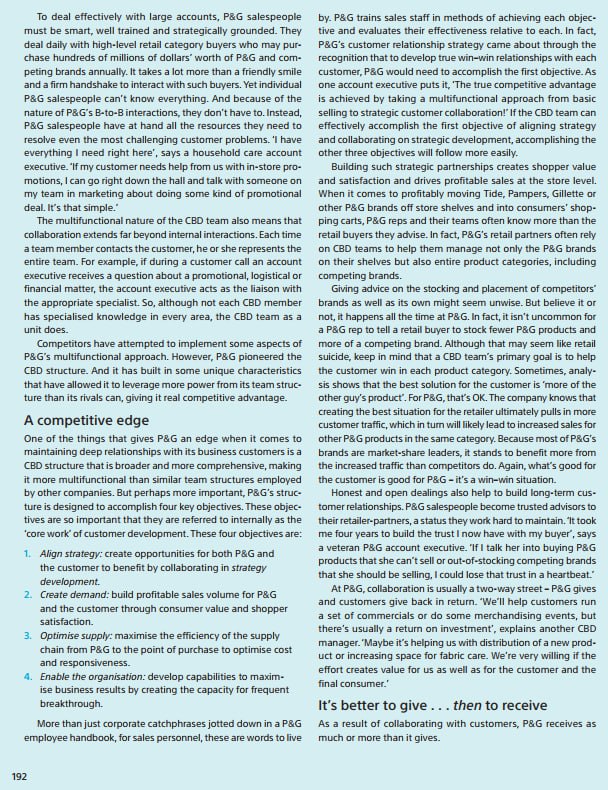
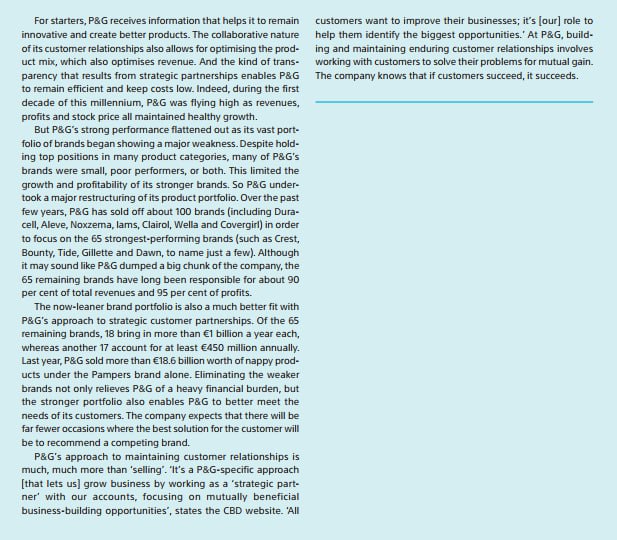
For decades, Procter \& Gamble has been at the top of almost every expert's A-list of outstanding marketing companies. The experts point to P\&G's stable of top-selling consumer brands or to the fact that year in and year out P\&G is the world's largest advertiser. Consumers seem to agree. You'll find at least one of P\&G's blockbuster brands in 99 per cent of all European households; in many homes, you'll find a dozen or more familiar P\&G products. But P\&G is also highly respected for something else - maintaining strategic partnerships with business buyers. P\&G recognises that building enduring relationships between consumers and its category leading brands starts with building enduring relationships with its large retail clients. On the front line of this effort is P\&G's iconic sales force. When it comes to selecting, training and managing salespeople, P&G sets the gold standard. The company employs a massive sales force of more than 5,000 salespeople worldwide. But at P\&G, it isn't just'sales' - it's 'Customer Business Development' (CBD). This might seem trivial, but at P\&G the distinction goes to the very core of the company's customer relationship strategy. Developing the customer's business P\&G understands that if its business customers don't do well, neither will the company. To grow its own business, therefore, P\&G must first grow the business of the retailers that sell its brands to final consumers. In P\&G's own words, 'CBD is more than mere 'selling' - it's a P\&G-specific approach which enables us to grow our business by working as a 'strategic partner' (as opposed to just a supplier) with those who ultimately sell our products to consumers.' Says one CBD manager, 'We depend on them as much as they depend on us.' By partnering with each other, P\&G and its customers create 'win-win' relationships that help both to prosper. Most P\&G customers are huge and complex businesses such as Carrefour, Tesco or Walmart/Asda - with thousands of stores and billions of dollars in revenues. Working with and selling to such customers can be a very complex undertaking. more than any single salesperson or regular sales team could accomplish. Instead, P\&G assigns a full CBD team to every large customer account. Each CBD team contains not only salespeople but also a full complement of specialists in every aspect of selling P\&G's consumer brands at the retail level. Teams vary in size depending on the customer. For example, in the US alone, it takes a team of 350P&G specialists to properly serve Walmart, far and away its biggest customer. Regardless of size, every team constitutes a complete, multifunctional customer service unit. Each team includes a manager and several account executives (each responsible for a specific P\&G product category), supported by specialists in marketing strategy, product development, operations, information systems, logistics, finance and human resources. For starters, P\&G receives information that helps it to remain innovative and create better products. The collaborative nature of its customer relationships also allows for optimising the product mix, which also optimises revenue. And the kind of transparency that results from strategic partnerships enables P\&G to remain efficient and keep costs low. Indeed, during the first decade of this millennium, P\&G was flying high as revenues, profits and stock price all maintained healthy growth. But P\&G's strong performance flattened out as its vast portfolio of brands began showing a major weakness. Despite holding top positions in many product categories, many of P\&G's brands were small, poor performers, or both. This limited the growth and profitability of its stronger brands. So P\&G undertook a major restructuring of its product portfolio. Over the past few years, P\&G has sold off about 100 brands (including Duracell, Aleve, Noxzema, lams, Clairol, Wella and Covergirl) in order to focus on the 65 strongest-performing brands (such as Crest, Bounty, Tide, Gillette and Dawn, to name just a few). Although it may sound like P\&G dumped a big chunk of the company, the 65 remaining brands have long been responsible for about 90 per cent of total revenues and 95 per cent of profits. The now-leaner brand portfolio is also a much better fit with P\&G's approach to strategic customer partnerships. Of the 65 remaining brands, 18 bring in more than 1 billion a year each, whereas another 17 account for at least 450 milion annually. Last year, P\&G sold more than 18.6 billion worth of nappy products under the Pampers brand alone. Eliminating the weaker brands not only relieves P\&G of a heavy financial burden, but the stronger portfolio also enables P\&G to better meet the needs of its customers. The company expects that there will be far fewer occasions where the best solution for the customer will be to recommend a competing brand. P\&G's approach to maintaining customer relationships is much, much more than 'selling'. 'It's a P\&G-specific approach [that lets us] grow business by working as a 'strategic partner' with our accounts, focusing on mutually beneficial business-building opportunities', states the CBD website. 'All customers want to improve their businesses; it's [our] role to help them identify the biggest opportunities.' At P\&G, building and maintaining enduring customer relationships involves working with customers to solve their problems for mutual gain. The company knows that if customers succeed, it succeeds
Step by Step Solution
There are 3 Steps involved in it

Get step-by-step solutions from verified subject matter experts