Question: 2. Do you think that Healthy We Ltd. would be a suitable organization in which to implement an organizational performance pay plan? Explain why or
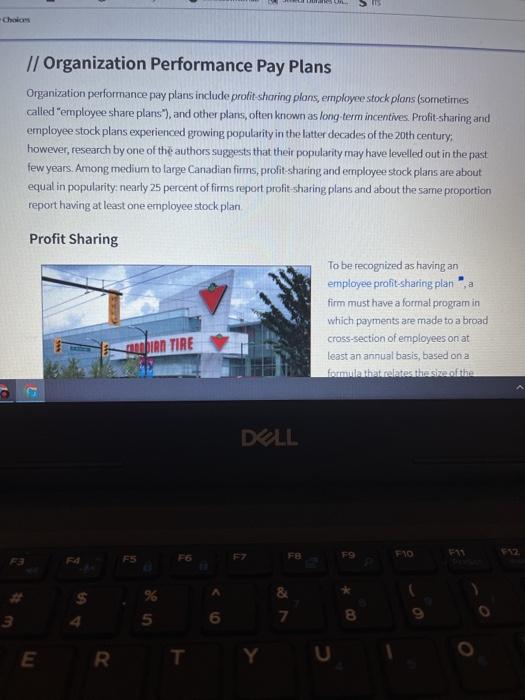
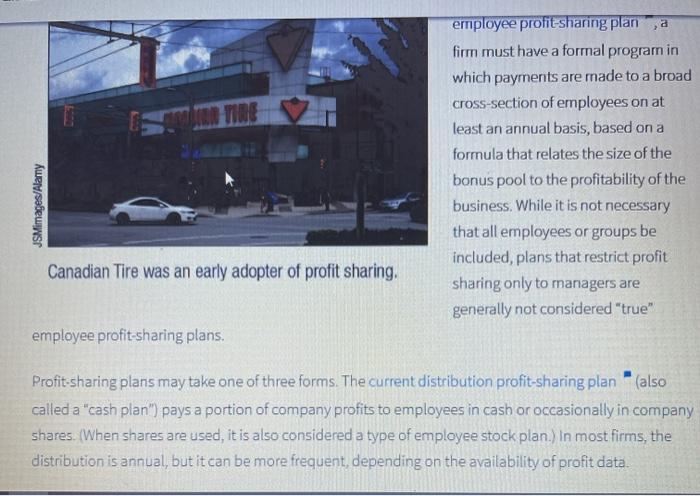
2. Do you think that Healthy We Ltd. would be a suitable organization in which to implement an organizational performance pay plan? Explain why or why not? (5 marks) Look at Chapters 3,4,5 and 11 for guidance HealthyWe Ltd. Healthywe Ltd. is a brand-new firm that will open its doors exactly three months from today. Its business objective is to provide health and wellness advice and services to the general public. HealthyWe Ltd. plans to provide customers with personalized advice geared to a customer's specific physical, mental and emotion needs so that they can be a healthier and happler version of themselves Services involve specialized full body evaluation services that include evaluations of and/or plans for nutrition, physical fitness and training and emotional well being. Each of these service offerings involving evaluations/plans can be purchased separately as well. In addition, HealthyWe Ltd. will also offer physical training equipment for sale at each of their locations. Their service/equipment offerings would be available for any customer from the ages of 10 to 70. In order to provide high-quality advice, each location will employ a physiotherapist (to provide advice on problems such as injuries or chronic back pain), a nutritionist (to provide advice on healthy eating habits and specifically focused eating plans that are best suited for personal wellness goals), a person with a bachelor's degree in kinesiology (to provide advice on training for various sports or other physical activities) and a massage therapist/yoga instructor (to provide advice on reducing issues like heightened anxiety and stress through movement and breathing work). In the initial appointment, a staff member will sit down with customers and develop a personalized program with various specialist offerings that meets their own specific objectives and needs. The remainder of the staff in the location will consist of a manager, with a Bachelor of Commerce degree, and sales staff, who will have at least high school diplomas. Locations will open in select shopping malls/strip plazas and will have long opening hours. It is expected that between 8 and 12 salespeople will be needed for each store. Because the stores are located in shopping malls, they will operate on a seven-day-a-week basis, open 9:00-9:00 weekdays, 9:00-6:00 Saturdays, and noon to 6:00 on Sundays. Aside from personally helping customers with their plans and evaluations, the roles of the physiotherapist, nutritionist, massage therapist/yoga instructor and kinesiologist will be to train other employees in understanding the service offerings and training equipment that can be used for various conditioning and rehabilitation purposes. Initially, sales staff will be given general training, but as time goes by, each salesperson will be expected to learn in depth about all the different services and pieces of equipment to help customers diagnose their needs accurately, and to be able to explain intent of the service offering and/or the proper use of the equipment. Because of the high level of training required, all employees will be full-time. The owner of the business and CEO has found through personal experience that she has been unable to find a one stop health and wellness offering that can help people Improve their well being both from the inside and the outside. In her previous experiences she has also found that the people selling training equipment had very limited knowledge and often gave poor advice on what to buy. how to use it or even what benefits the equipment can provide the user. The owner of the business and CEO has secured funding from private investors and from a large Canadian venture capital fund. In order to get volume discounts on the equipment she will be purchasing and to beat competitors into the market, she wants to start off quite large, with stores in major cities in Ontario and the four western provinces, before expanding to Quebec and the Atlantic provinces. She knows that this is a risky strategy, and that cost control will be essential to keep the business going long enough to become well known and develop a stable clientele. She does not expect the business to make a profit for at least one year, or maybe even two. Her investors are in full support of this strategy Main competitors to HealthyWe Ltd. will be individual health care service offerings, sporting goods megastores, bulk warehouse retailers and department and discount stores, each of which sells some of the same equipment. Some of these outlets will be able to price their equipment lower than Healthy We Ltd. will be able to, but none have the range of equipment that Healthy We Ltd. will have, and none will provide the personalized and complementary wellness services that Healthy We Ltd will. The owner believes that the key to her business success will be highly motivated and knowledgeable employees who have a strong concern for their customers and who are able to work as a team with the other employees to provide the best possible customer service. Since no two customers are exactly alike, employees will have to be innovative in developing solutions that fit their needs. It will also be crucial to keep up with the latest health, fitness and training trends, as knowledge about health and fitness is continually increasing, along with new and different types of specialized services and equipment. A key aspect of company strategy is to be the most up-to-date and advanced supplier of new services, products and techniques. Although the owner has given a lot of thought to her business, one thing she hasn't really given much thought to is how to compensate her employees. Since she doesn't really know much about compensation, she tends to feel that the safest thing would be do become one Performance Pay Performance pay can be defined as any type of financial reward provided only when certain specified performance results occur. It is sometimes known as "performance contingent pay," "variable pay," or "at-risk pay." Pay-for-performance plans can be classified into three main categories, depending on whether the performance relates to the individual employee, the group or work team, or the entire organization. Individual performance pay plons include piece rates, commissions, merit pay, and targeted incentives. Group performance pay plans include productivity gain-sharing plans, goal-sharing plans, and other types of team-based pay. Organizational performance pay plons include employee profit-sharing plans, employee stock plans, and other organizational pay plans. Sie Why Use Performance Pay? Paying employees only when the desired performance takes place sounds like a wonderful idea-if you are an employer. The latter part of the 20th century did see a dramatic growth in performance pay, particularly group and organizational performance pay. Yet many employers still choose not to use performance pay at all, and among those that do, it usually constitutes a relatively small proportion of total compensation So, why should organizations consider utilizing performance pay? Performance pay plans have several advantages: 1. Properly designed, they can signal key employee behaviours and motivate employees to achieve them. 2. They can reduce the need for othed types of mechanisms for controlling employee behaviour. When employees know that their pay is dependent on performing particular behaviours, they won't need a supervisor watching them to make sure they are working 3. Such plans can raise employee interest in performance and provide employees with information about their current performance levels. 4. Different types of performance pay can be used to support specific managerial strategies. For example, individual performance pay can support a classical managerial strategy. Group-or organization-based performance pay can support a high-involvement managerial strategy 5. Finally, performance pay plans make pay more variable and thus can help link compensation levels to the firm's ability to pay. This linkage helps stabilize an organization's employment levels, lessening the need to lay off employees in difficult times only to rehire them when business improves. This employment stability has advantages for both employers and employees, since employers risk losing employees whenever they are forced to lay them off, and employees often prefer reduced-pay employment to layoffs Disadvantages of Performance Pay It is difficult to generalize about the disadvantages of performance pay plans because the types of performance pay plans differ radically and each has its own specific advantages, disadvantages, and limitations. (The specific advantages and drawbacks for each type of performance pay plan will be covered in Chapter 5.) That said, one general drawback is that employees generally prefer predictable and certain rewards to unpredictable and uncertain rewards. Of course, employees usually do not object to performance pay if it is clearly an add-on, to top off base pay and indirect pay. But employees will generally resist substitution of performance pay for base pay or indirect pay. To induce employees to accept this substitution, it may be necessary to offer higher total compensation than would otherwise be necessary. Some organizations that rely heavily on performance pay appear to pay a very steep price for so doing. For example, The Globe and Mail reported that some stock traders received as much as $800,000 in gross pay several years ago. Is it really necessary to pay this much? Is it really efficient to pay this much? Research in the United States indicates that workers on incentive systems average about 20 percent more earnings than comparable workers on time-based pay systems.4 Sometimes the higher total compensation may not even retain the high-priced employees. At Canaccord Genuity Group Inc., Canada's largest independent brokerage, between 30 and 40 senior investment bankers, traders and analysts at the director and managing director level received compensation exceeding $500,000 a year. After losing some of its biggest producers, Canaccord started to request its senior employees to commit to staying with the company for the next year in order to receive their fiscal year-end bonuses In addition, as discussed in previous chapters, performance pay may cause employees to focus only on aspects of behaviour that are being measured, ignoring other unmeasured but still important behaviours. If poorly designed, performance pay can have unanticipated negative consequences. Getting performance pay to work right is usually no easy matter, base pay is often much simpler and more flexible. Overall, research undertaken by one of the authors shows that performance pay plans have a substantial failure rate, as judged by the relatively high discontinuation rate of these plans. // Organization Performance Pay Plans Organization performance pay plans include profit sharing plans, employee stock plons (sometimes called "employee share plans"), and other plans, often known as long-term incentives. Profit-sharing and employee stock plans experienced growing popularity in the latter decades of the 20th century, however, research by one of the authors suggests that their popularity may have levelled out in the past few years. Among medium to large Canadian firms, profit-sharing and employee stack plans are about equal in popularity: nearly 25 percent of firms report profit sharing plans and about the same proportion report having at least one employee stock plan Profit Sharing To be recognized as having an employee profit-sharing plan firm must have a formal program in which payments are made to a broad cross-section of employees on at least an annual basis, based on a formula that relates the site of the DIRD TIRE DOLL F8 F6 FS FO F $ % & 5 6 7 8 ER Y JSMimages/Alamy employee profit-sharing plan firm must have a formal program in which payments are made to a broad cross-section of employees on at least an annual basis, based on a formula that relates the size of the bonus pool to the profitability of the business. While it is not necessary that all employees or groups be included, plans that restrict profit sharing only to managers are generally not considered "true" Canadian Tire was an early adopter of profit sharing, employee profit-sharing plans. Profit-sharing plans may take one of three forms. The current distribution profit-sharing plan (also called a "cash plan") pays a portion of company profits to employees in cash or occasionally in company shares. (When shares are used, it is also considered a type of employee stock plan. In most firms, the distribution is annual, but it can be more frequent, depending on the availability of profit data. Chapter Performance Ray Chol X magnede 7dddtereld-a 16 Bacabbd06 board Webmail S Seneca Colege Seneca TheHub Seneca Libraries On ITS e choices In a deferred profit-sharing plan (DPSP) an employee's share of the profit bonus pool is placed in a trust fund to be distributed at a future date, usually on the employee's retirement or on termination of employment. This type of plan is often used as a type of retirement savings plan. A combination profit sharing plan provides both cash (or shares) and a deferred component. A combination plan gives the employee the opportunity to take advantage of the provisions for tax deferral in federal tax legislation to help build some retirement income, it also provides a more visible incentive to employees through the cash portion Advantages of Profit-Sharing Plans As part of a study about profit sharing, researchers asked a business owner whether his firm had employee profit sharing His reply: "Give away my profits to employees? Why would I want to do that? Why indeed would employers want to share their profits with their employees? 1. When the interests of employees are aligned with those of the employer, employees may be more motivated to improve company performance Profit sharing can contribute to the development of favourable group norms, improved cooperation among employees and between employees and management, improved labour-management relations, and greater organizational identification, DOLL 5 F6 FZ FB F9 F10 511 2. Improved norms can reduce the need for supervision, thereby reducing costs. Profit sharing also aligns with and supports a move toward high-involvement management for firms moving in that direction 3. Profit sharing is a reward related to company ability to pay. By adding profit sharing to its compensation mix, an employer can offer a more lucrative compensation package when conditions permit , but is not locked into higher fixed pay, since it doesn't have to continue profit-sharing payments when business conditions are unfavourable and the firm makes no profits. In the same vein, profit sharing is the only way that some organizations can afford to offer a retirement plan, since it means they have no obligation to contribute to the pension plan when they cannot afford to do so 4. Recent Canadian research shows that, on average, employees in firms with profit sharing have higher total earnings than those in firms that do not provide profit sharing 34 This helps the firm attract and retain employees. 5. Profit sharing may reduce the need for layoffs in poor economic circumstances, since labour costs are automatically adjusted downward. This reduces the risk of losing good employees because of layoffs; it also provides employees with greater job security 6. If profit sharing helps create a more cooperative workplace, employees may gain greater job satisfaction from working in a harmonious environment. 7. Finally profit sharing is farsimpler to set up and administer than plans such as gain sharing, Profit os many, prontsnangis tar simpler to set up and administer than plans such as garrestaring. measures are readily available in virtually all firms. There is no need to compute base lines or to try to quantify the value of cost savings. In addition, administration is relatively simple, and the plan and its results are relatively easy to communicate to employees. Disadvantages of Profit Sharing As with all performance pay plans, profit sharing also has its disadvantages: 1. It may not pay off for the employer. The costs of the profit-sharing bonus and for administering the profit-sharing system may exceed the benefits. 2. As a collective reward system, profit sharing may actually reduce employee performance by causing free riding, just as in group-based pay systems. Because the connection between individual performance and the expected reward for that performance is more fragile, profit sharing has a weaker "line of sight" between individual employee performance and the bonus amount than group pay and so may have little direct impact on employee performance. So many factors intervene between worker performance and company profitability that worker performance can improve dramatically while profits actually go down or even disappear-owing, for example, to market conditions or poor management decisions. 3. Unions may oppose profit sharing because its results are subject to management manipulation, or