Question: .2 e -'-' h _ Delis ilion [-2 am or pl o In this part of the assignment, we will explore the idea of linear
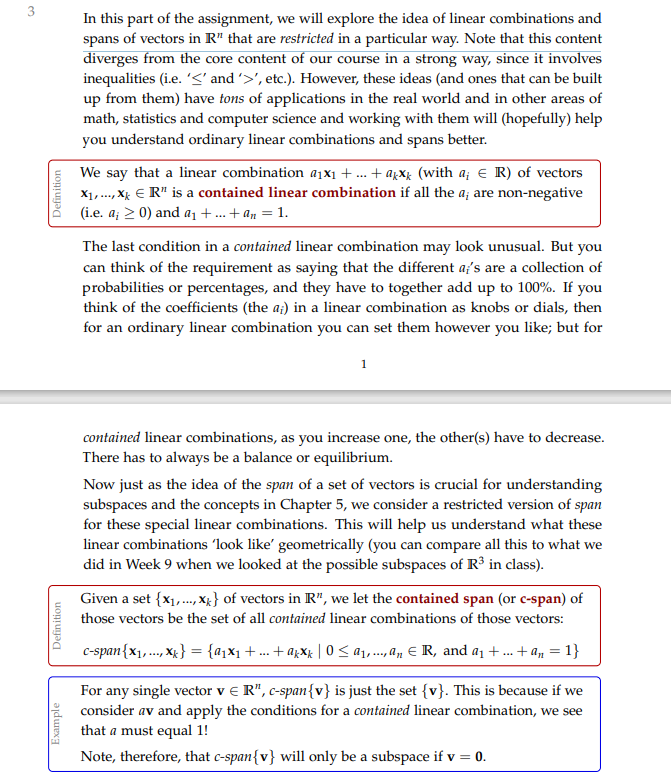
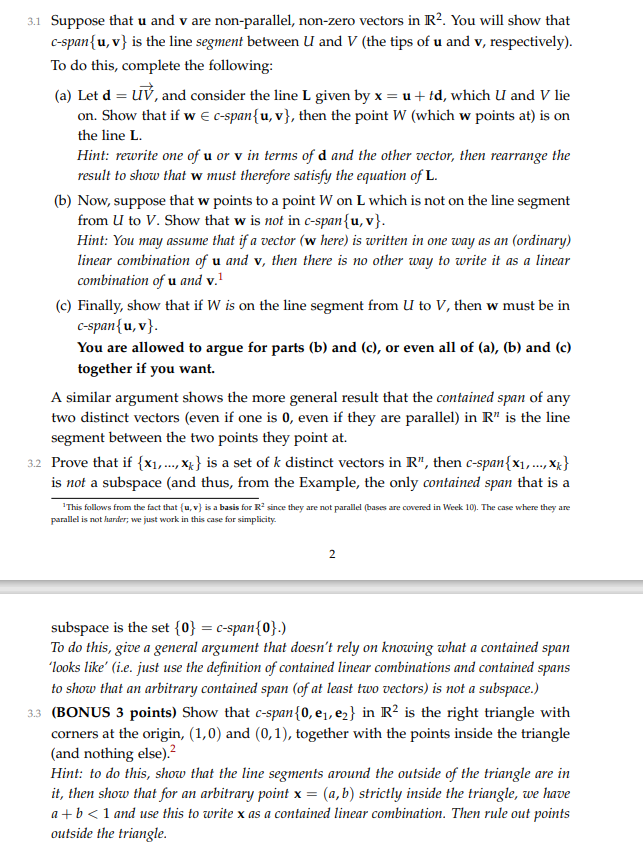
.2 e "-'-' h _ Delis ilion [-2 am or pl o In this part of the assignment, we will explore the idea of linear combinations and spans of vectors in R" that are testied in a particular way. Note that this content WW inequalities (Le. '5' and ".12\". etc]. However. these ideas {and ones that can be built up from them] have tons of applications in the real world and in other areas of math. statistics and computer science and working with them will {hopefully} help you understand ordinary linear combinations and spans better. We say that a linear combination else] + +1ka [with e,- E R} of vectors annexe E R" is a contained linear combination it" all the el- are nonnegative (Le. a.- 33 ] and all + +n\" = 1. The last condition in a contained linear combination may look unusual. But you can think of the requirement as Saying that the different efs are a collection of probabilities or percentages, and they have to together add up to l't'a. If you think of the coefficients (the as} in a linear combination as knobs or dials, then for an ordinary Linear combination you can set them however you like; but for l contained linear combinations, as you increase one, the other[s] have to decrease. There has to always be a balance or equilibrium. Now just as the idea of the span of a set of vectors is crucial for understanding subspaces and the concepts in Chapter 5. we consider a restricted version of span for these special linear combinations. This will help us understand what these linear combinations \"look like' geometrically {you can compare all this to what we did in Week s when we looked at the possible subspaces of R3 in class}. Given a set {it} , ..., act} of vectors in IR\". we let the contained span {or c-span} of those vectors be the set of all contained linear combinations of those vectors: c-spmn{x1,...,xk}={n1x1+...+nkxy| E \"1,"...1'3\" E R, and e] +...+ itII = 1} For any single vector v E R\3.1 Suppose that u and v are non-parallel, non-zero vectors in R2. You will show that c-span { u, v} is the line segment between U and V (the tips of u and v, respectively). To do this, complete the following: (a) Let d = UV, and consider the line L given by x = u + td, which U and V lie on. Show that if w ( c-span { u, v}, then the point W (which w points at) is on the line L. Hint: rewrite one of u or v in terms of d and the other vector, then rearrange the result to show that w must therefore satisfy the equation of L. (b) Now, suppose that w points to a point W on L which is not on the line segment from U to V. Show that w is not in c-span { u, v}. Hint: You may assume that if a vector (w here) is written in one way as an (ordinary) linear combination of u and v, then there is no other way to write it as a linear combination of u and v.] (c) Finally, show that if W is on the line segment from U to V, then w must be in c-span { u, v}. You are allowed to argue for parts (b) and (c), or even all of (a), (b) and (c) together if you want. A similar argument shows the more general result that the contained span of any two distinct vectors (even if one is 0, even if they are parallel) in R" is the line segment between the two points they point at. 3.2 Prove that if {x1, ..., Xx} is a set of k distinct vectors in R", then c-span {x1, .., Xx} is not a subspace (and thus, from the Example, the only contained span that is a 'This follows from the fact that {u, v) is a basis for R3 since they are not parallel (bases are covered in Week 10). The case where they are parallel is not harder; we just work in this case for simplicity. 2 subspace is the set {0} = c-span {0}.) To do this, give a general argument that doesn't rely on knowing what a contained span 'looks like' (i.e. just use the definition of contained linear combinations and contained spans to show that an arbitrary contained span (of at least two vectors) is not a subspace.) 3.3 (BONUS 3 points) Show that c-span (0, e1, ez} in R2 is the right triangle with corners at the origin, (1,0) and (0, 1), together with the points inside the triangle (and nothing else). Hint: to do this, show that the line segments around the outside of the triangle are in it, then show that for an arbitrary point x = (a, b) strictly inside the triangle, we have a + b
Step by Step Solution
There are 3 Steps involved in it
1 Expert Approved Answer
Step: 1 Unlock
Question Has Been Solved by an Expert!
Get step-by-step solutions from verified subject matter experts
Step: 2 Unlock
Step: 3 Unlock
Students Have Also Explored These Related Mathematics Questions!









 Study Help