







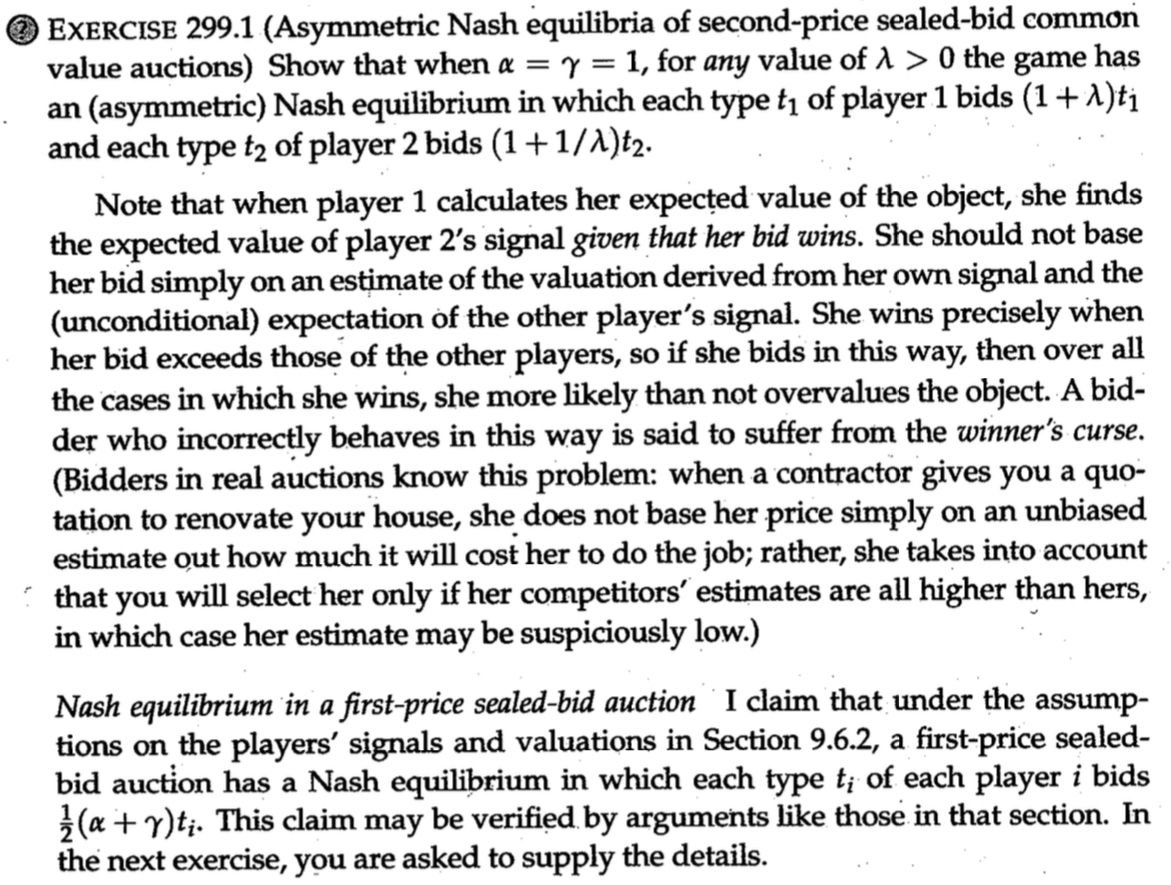
Question: ( 2 ) EXERCISE 2 9 9 . 1 ( Asymmetric Nash equilibria of second - price sealed - bid common value auctions ) Show
EXERCISE Asymmetric Nash equilibria of secondprice sealedbid common value auctions Show that when alphagamma for any value of lambda the game has an asymmetric Nash equilibrium in which each type t of player bids lambda t and each type t of player bids lambda t
Note that when player calculates her expected value of the object, she finds the expected value of player s signal given that her bid wins. She should not base her bid simply on an estimate of the valuation derived from her own signal and the unconditional expectation of the other player's signal. She wins precisely when her bid exceeds those of the other players, so if she bids in this way, then over all the cases in which she wins, she more likely than not overvalues the object. A bidder who incorrectly behaves in this way is said to suffer from the winner's curse. Bidders in real auctions know this problem: when a contractor gives you a quotation to renovate your house, she does not base her price simply on an unbiased estimate out how much it will cost her to do the job; rather, she takes into account that you will select her only if her competitors' estimates are all higher than hers, in which case her estimate may be suspiciously low.
Nash equilibrium in a firstprice sealedbid auction I claim that under the assumptions on the players' signals and valuations in Section a firstprice sealedbid auction has a Nash equilibrium in which each type ti of each player i bids fracalphagamma ti This claim may be verified by arguments like those in that section. In the next exercise, you are asked to supply the details.
Step by Step Solution
There are 3 Steps involved in it
1 Expert Approved Answer
Step: 1 Unlock

Question Has Been Solved by an Expert!
Get step-by-step solutions from verified subject matter experts
Step: 2 Unlock
Step: 3 Unlock
 Study Help