







Question: 2. Experimental Procedure In this assignment, we will look performing Fourier analysis on different images. Part A Task 1: Below is a python program that
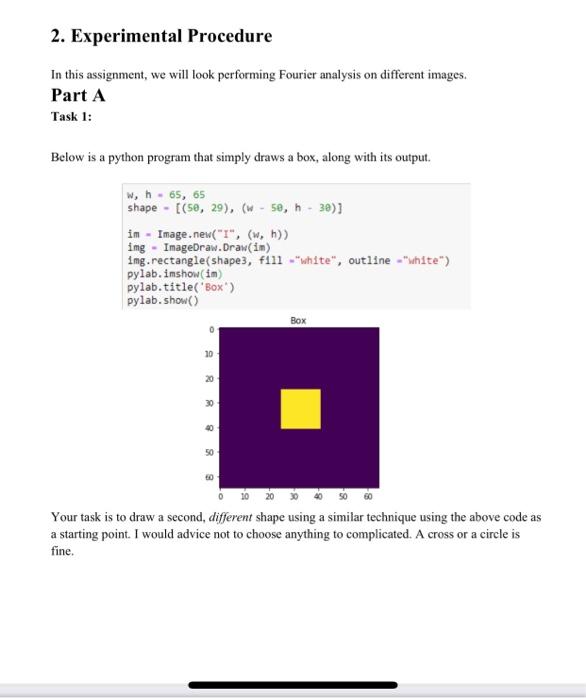
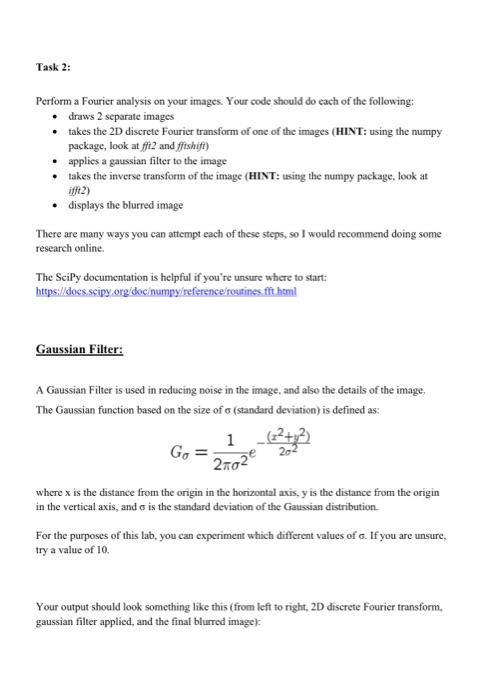
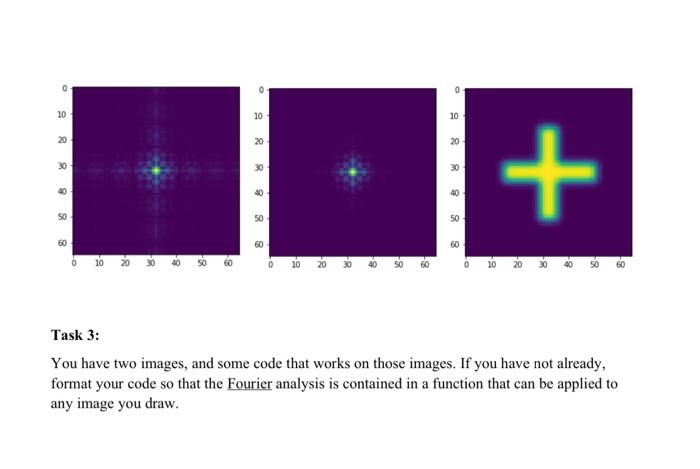
2. Experimental Procedure In this assignment, we will look performing Fourier analysis on different images. Part A Task 1: Below is a python program that simply draws a box, along with its output. w, h - 65, 65 shape - [(50, 29), (w - 50, h - 30)] im - Image.new("1", (w, h)) img - ImageDraw.Draw(im) img.rectangle(shape3, fill white", outline "white") pylab.imshow(im) pylab.title('Box) pylab.show() Box 0 20 30 8 50 Your task is to draw a second, different shape using a similar technique using the above code as a starting point. I would advice not to choose anything to complicated. A cross or a circle is fine. Task 2: Perform a Fourier analysis on your images. Your code should do each of the following: draws 2 separate images takes the 2D discrete Fourier transform of one of the images (HINT: using the numpy package, look at fft2 and fftshift) applies a gaussian filter to the image takes the inverse transform of the image (HINT: tsing the numpy package, look at ifft2) displays the blurred image There are many ways you can attempt each of these steps, so I would recommend doing some research online The SciPy documentation is helpful if you're unsure where to start: https://docs.ssipy.org/documpy/reference routines fft hom Gaussian Filter: A Gaussian Filter is used in reducing noise in the image, and also the details of the image. The Gaussian function based on the size of 6 (standard deviation) is defined as: 1 Go 2702 where x is the distance from the origin in the horizontal axis, y is the distance from the origin in the vertical axis, and is the standard deviation of the Gaussian distribution For the purposes of this lab, you can experiment which different values of c. If you are unsure, try a value of 10. Your output should look something like this (from left to right, 2D discrete Fourier transform, gaussian filter applied, and the final blurred image) 0 0 10 10 10 20 20 20 30 30 + 40 40 40 50 50 50 60 60 60 6 10 20 30 50 60 0 20 10 5 40 50 0 10 20 0 Task 3: You have two images, and some code that works on those images. If you have not already, format your code so that the Fourier analysis is contained in a function that can be applied to any image you draw
Step by Step Solution
There are 3 Steps involved in it

Get step-by-step solutions from verified subject matter experts
 Study Help