







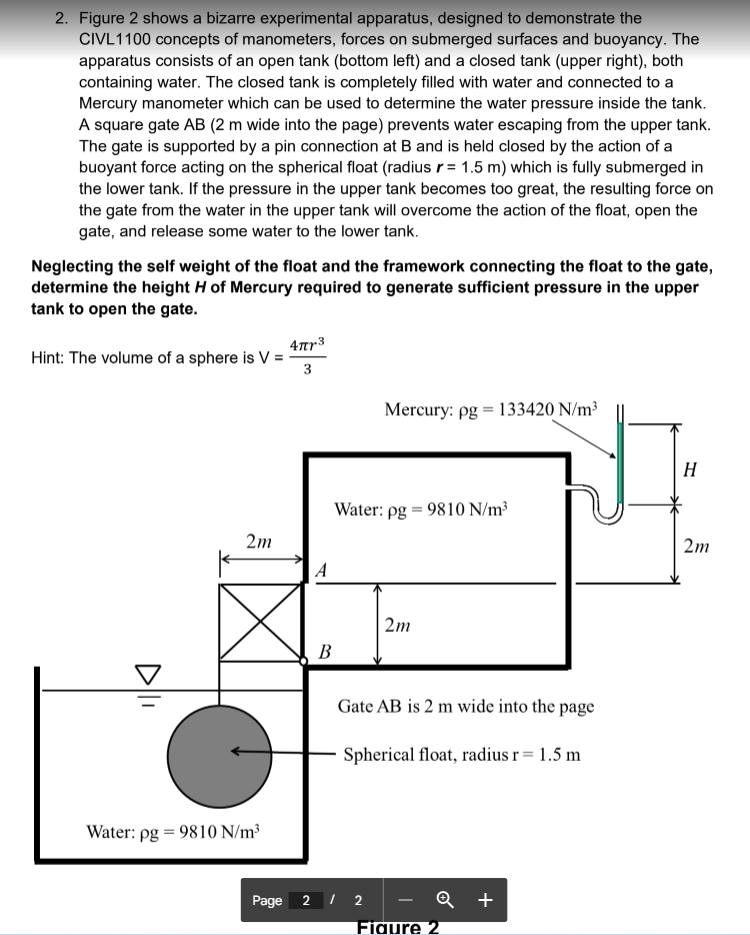
Question: 2 . Figure 2 shows a bizarre experimental apparatus, designed to demonstrate the CIVL 1 1 0 0 concepts of manometers, forces on submerged surfaces
Figure shows a bizarre experimental apparatus, designed to demonstrate the CIVL concepts of manometers, forces on submerged surfaces and buoyancy. The apparatus consists of an open tank bottom left and a closed tank upper right both containing water. The closed tank is completely filled with water and connected to a Mercury manometer which can be used to determine the water pressure inside the tank. A square gate AB m wide into the page prevents water escaping from the upper tank. The gate is supported by a pin connection at B and is held closed by the action of a buoyant force acting on the spherical float radius rmathrm~m which is fully submerged in the lower tank. If the pressure in the upper tank becomes too great, the resulting force on the gate from the water in the upper tank will overcome the action of the float, open the gate, and release some water to the lower tank.
Neglecting the self weight of the float and the framework connecting the float to the gate, determine the height H of Mercury required to generate sufficient pressure in the upper tank to open the gate.
Hint: The volume of a sphere is mathrmVfracpi r
Step by Step Solution
There are 3 Steps involved in it
1 Expert Approved Answer
Step: 1 Unlock

Question Has Been Solved by an Expert!
Get step-by-step solutions from verified subject matter experts
Step: 2 Unlock
Step: 3 Unlock
 Study Help