



Question: 2. Figure 2 shows a roller rolling and slipping at the same time on a slippery surface. The center of the roller moves with
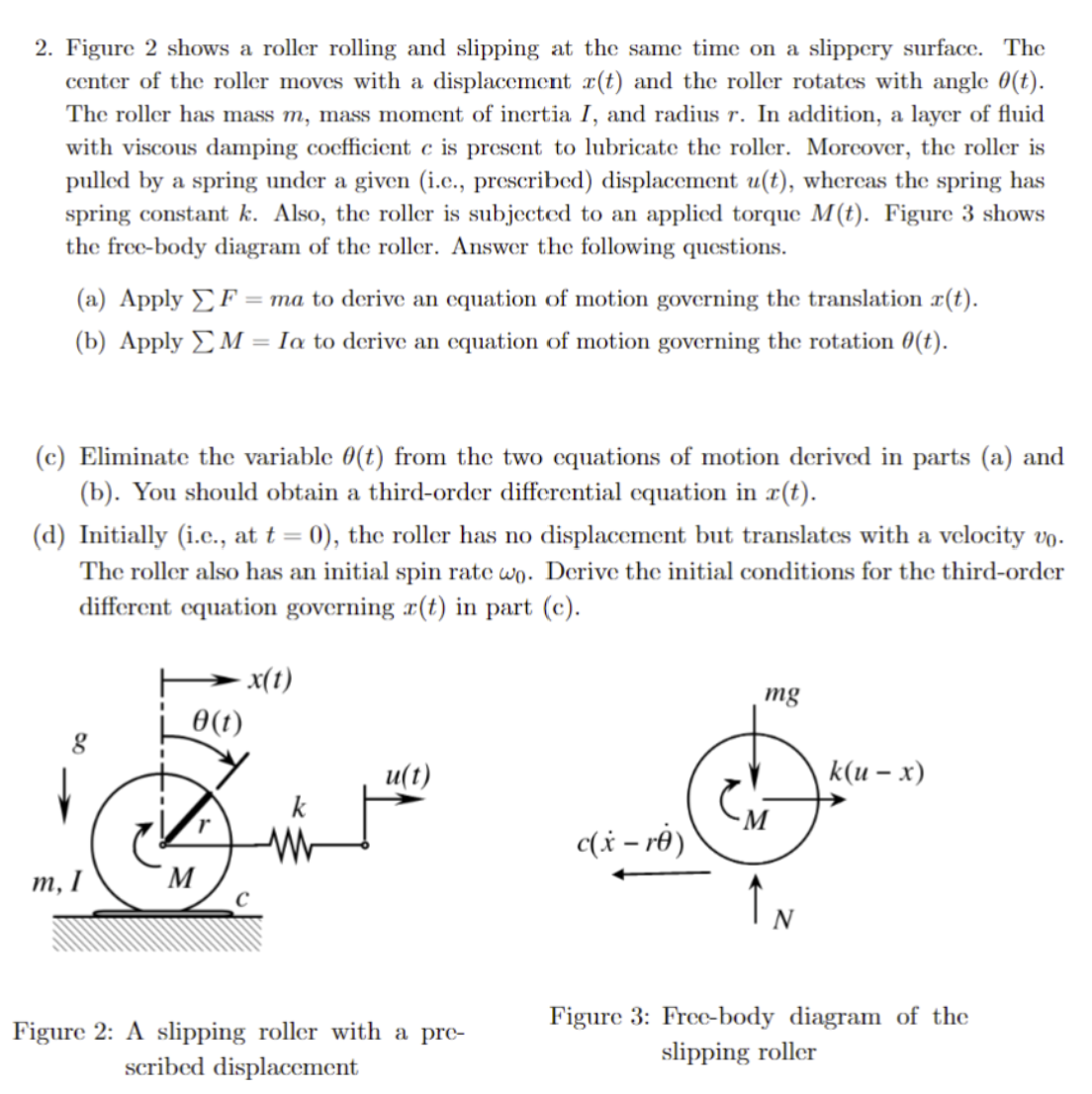
2. Figure 2 shows a roller rolling and slipping at the same time on a slippery surface. The center of the roller moves with a displacement r(t) and the roller rotates with angle 0(t). The roller has mass m, mass moment of inertia I, and radius r. In addition, a layer of fluid with viscous damping coefficient c is present to lubricate the roller. Moreover, the roller is pulled by a spring under a given (i.c., prescribed) displacement u(t), whereas the spring has spring constant k. Also, the roller is subjected to an applied torque M(t). Figure 3 shows the free-body diagram of the roller. Answer the following questions. (a) Apply F = ma to derive an equation of motion governing the translation r(t). (b) Apply M = Ia to derive an equation of motion governing the rotation 0(t). (c) Eliminate the variable 0(t) from the two equations of motion derived in parts (a) and (b). You should obtain a third-order differential equation in r(t). (d) Initially (i.c., at t = 0), the roller has no displacement but translates with a velocity v. The roller also has an initial spin rate wo. Derive the initial conditions for the third-order different equation governing r(t) in part (c). m, I I I 0 (t) x(t) CMC k u(t) Figure 2: A slipping roller with a pre- scribed displacement c(i r) mg M k(u - x) Figure 3: Free-body diagram of the slipping roller
Step by Step Solution
3.45 Rating (152 Votes )
There are 3 Steps involved in it
In the scenario depicted we have a roller with mass m moment of inertia I and radius r experiencing a translational displacement xt and a rotation the... View full answer

Get step-by-step solutions from verified subject matter experts