



Question: 2. Figure 5 depicts how power is distributed from the power company to their customers through a combination of two transformers and a transmission
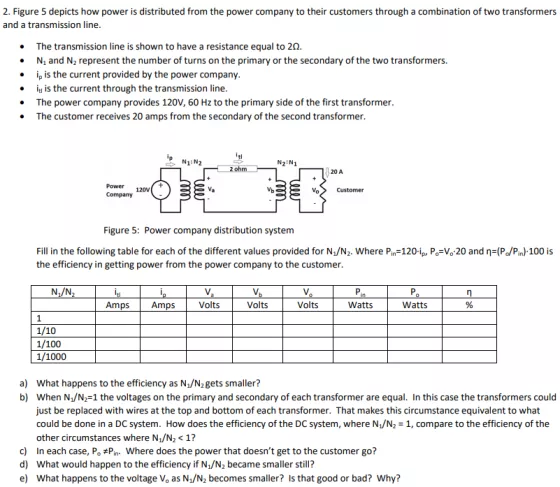
2. Figure 5 depicts how power is distributed from the power company to their customers through a combination of two transformers and a transmission line. The transmission line is shown to have a resistance equal to 20. N, and N, represent the number of turns on the primary or the secondary of the two transformers. i, is the current provided by the power company. iu is the current through the transmission line. The power company provides 120V, 60 Hz to the primary side of the first transformer. The customer receives 20 amps from the secondary of the second transformer. 2 ohm 20 A Power 120v Company Customer Figure 5: Power company distribution system Fill in the following table for each of the different values provided for N/N2. Where P=120-ip, Pe=Vo 20 and n=(P/Pinl-100 is the efficiency in getting power from the power company to the customer. N,/N V. Volts P. Amps Amps Volts Volts Watts Watts 1 1/10 1/100 1/1000 a) What happens to the efficiency as N/N2 gets smaller? b) When N/N;=1 the voltages on the primary and secondary of each transformer are equal. In this case the transformers could just be replaced with wires at the top and bottom of each transformer. That makes this circumstance equivalent to what could be done in a DC system. How does the efficiency of the DC system, where N/N; = 1, compare to the efficiency of the other circumstances where N/N,
Step by Step Solution
3.30 Rating (147 Votes )
There are 3 Steps involved in it
Anscuer Griventhat The Curent recelued by The Castomer is ie20 ... View full answer

Get step-by-step solutions from verified subject matter experts