







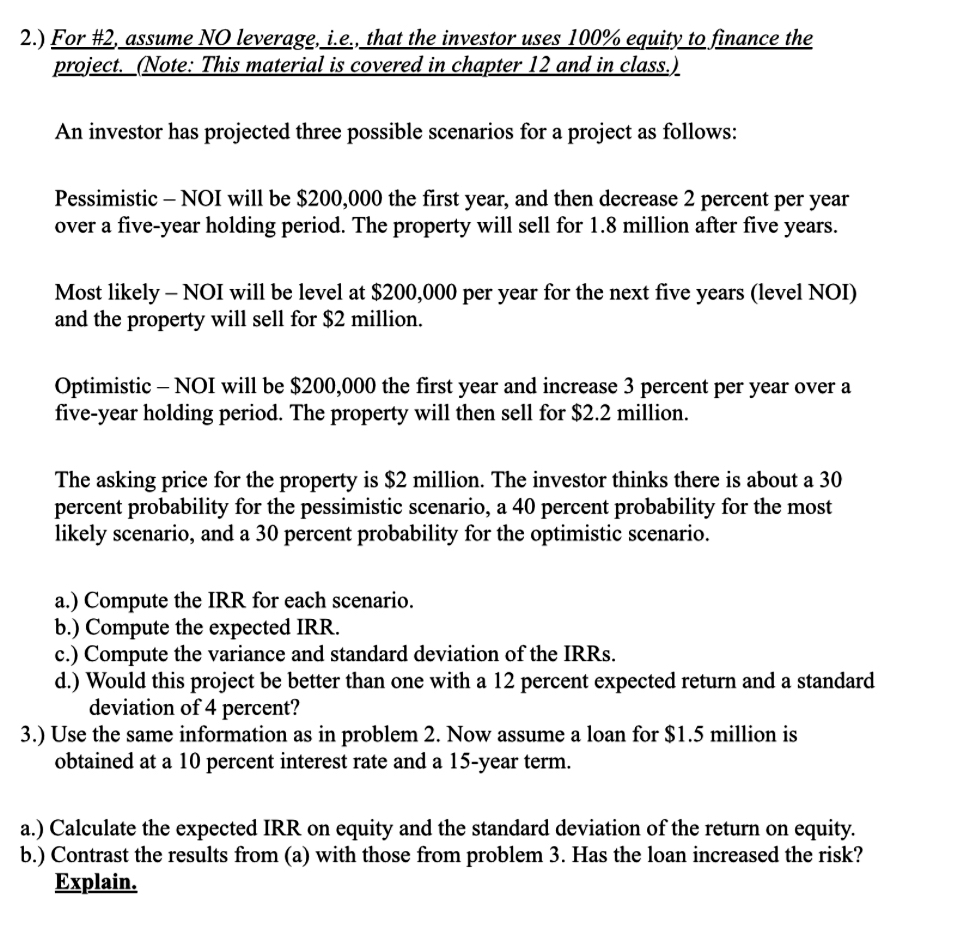
Question: 2 . ) For # 2 , assume NO leverage, i . e . , that the investor uses 1 0 0 % equity to
For # assume NO leverage, ie that the investor uses equity to finance the project. Note: This material is covered in chapter and in class.
An investor has projected three possible scenarios for a project as follows:
Pessimistic NOI will be $ the first year, and then decrease percent per year over a fiveyear holding period. The property will sell for million after five years.
Most likely NOI will be level at $ per year for the next five years level NOI and the property will sell for $ million.
Optimistic NOI will be $ the first year and increase percent per year over a fiveyear holding period. The property will then sell for $ million.
The asking price for the property is $ million. The investor thinks there is about a percent probability for the pessimistic scenario, a percent probability for the most likely scenario, and a percent probability for the optimistic scenario.
a Compute the IRR for each scenario.
b Compute the expected IRR.
c Compute the variance and standard deviation of the IRRs.
d Would this project be better than one with a percent expected return and a standard deviation of percent?
Use the same information as in problem Now assume a loan for $ million is obtained at a percent interest rate and a year term.
a Calculate the expected IRR on equity and the standard deviation of the return on equity.
b Contrast the results from a with those from problem Has the loan increased the risk? Explain.
Step by Step Solution
There are 3 Steps involved in it
1 Expert Approved Answer
Step: 1 Unlock

Question Has Been Solved by an Expert!
Get step-by-step solutions from verified subject matter experts
Step: 2 Unlock
Step: 3 Unlock
 Study Help