







Question: 2. For 200 runners in a marathon (observations), the RunTime data set provides the following data: - LastDistance (in miles): the length of the runner's
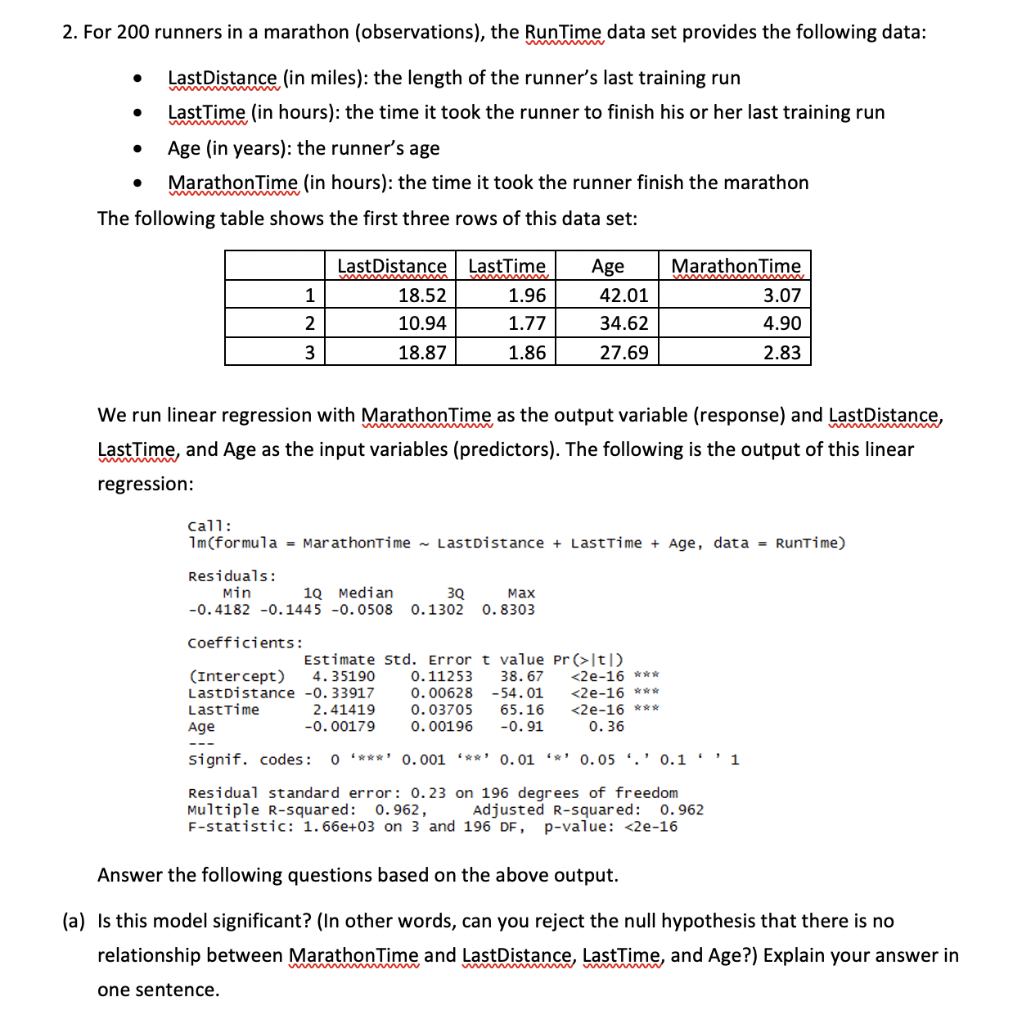
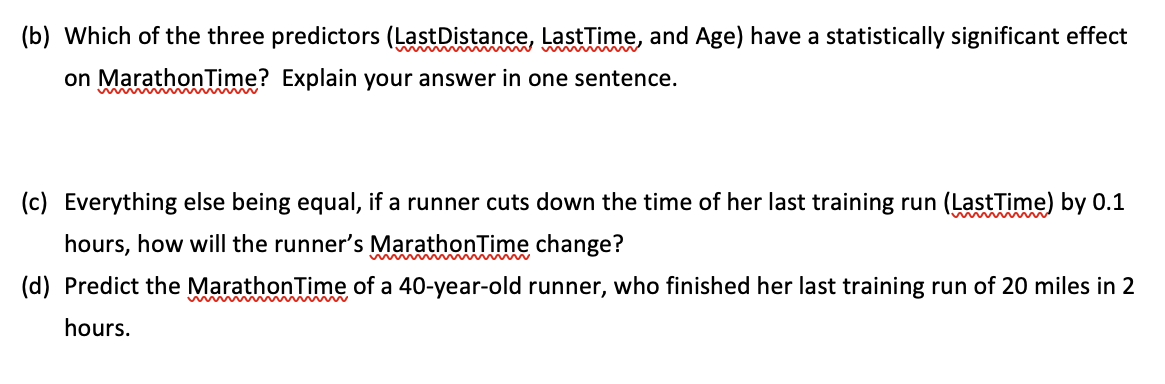
2. For 200 runners in a marathon (observations), the RunTime data set provides the following data: - LastDistance (in miles): the length of the runner's last training run - LastTime (in hours): the time it took the runner to finish his or her last training run - Age (in years): the runner's age - MarathonTime (in hours): the time it took the runner finish the marathon The following table shows the first three rows of this data set: We run linear regression with MarathonTime as the output variable (response) and LastDistance, LastTime, and Age as the input variables (predictors). The following is the output of this linear regression: Answer the following questions based on the above output. (a) Is this model significant? (In other words, can you reject the null hypothesis that there is no relationship between MarathonTime and LastDistance, LastTime, and Age?) Explain your answer in one sentence. (b) Which of the three predictors (LastDistance, LastTime, and Age) have a statistically significant effect on MarathonTime? Explain your answer in one sentence. (c) Everything else being equal, if a runner cuts down the time of her last training run (LastTime) by 0.1 hours, how will the runner's MarathonTime change? (d) Predict the MarathonTime of a 40-year-old runner, who finished her last training run of 20 miles in 2 hours
Step by Step Solution
There are 3 Steps involved in it

Get step-by-step solutions from verified subject matter experts
 Study Help