







Question: 2. For any binary relation D on a set X, define the binary relation > by letting x y y we do not have a
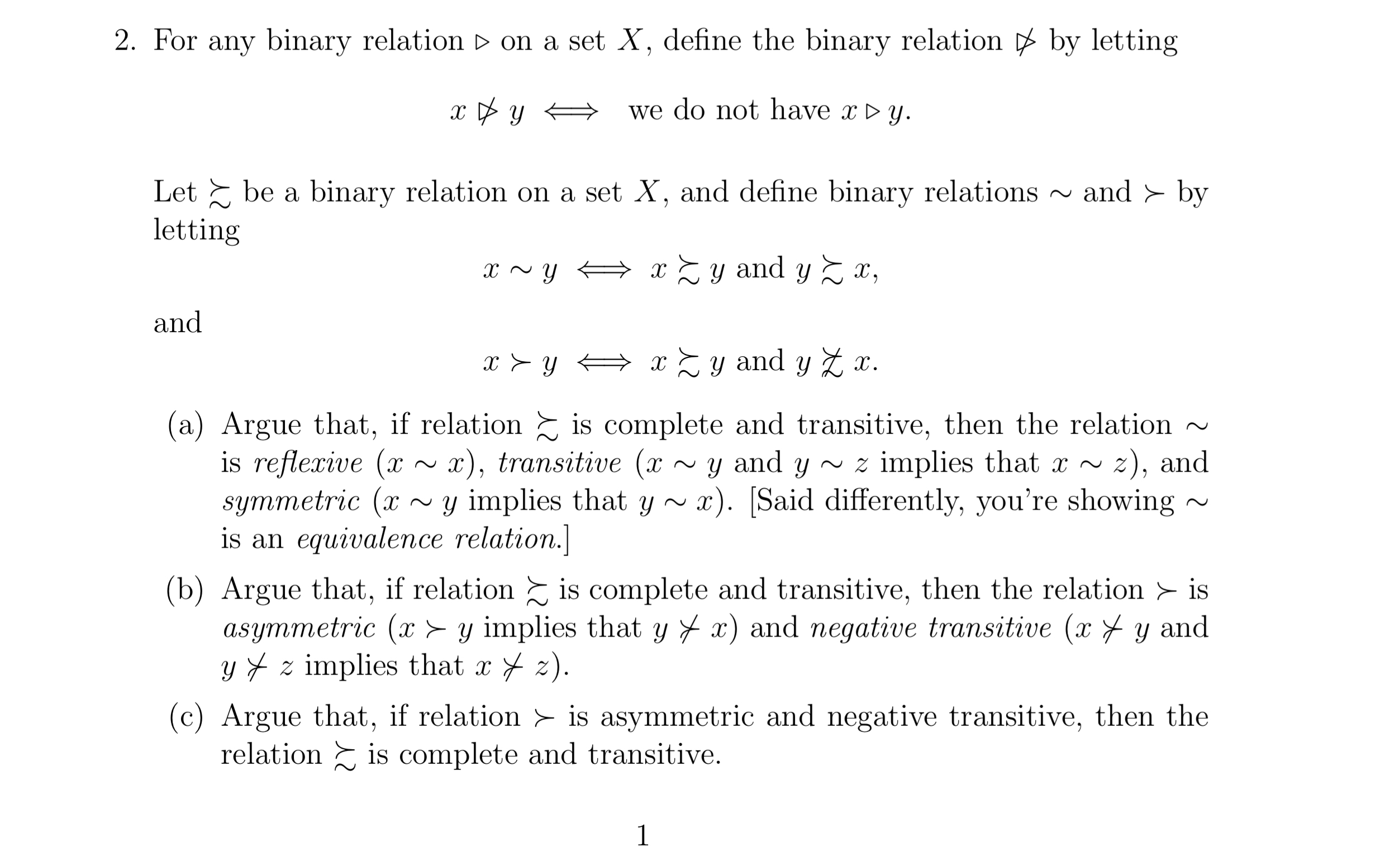
2. For any binary relation D on a set X, define the binary relation > by letting x y y we do not have a Dy. Let _ be a binary relation on a set X, and define binary relations ~ and > by letting dry xy andy ~ x, and xxy x-yandy Z x. (a) Argue that, if relation ~ is complete and transitive, then the relation ~ is reflexive (x ~ x), transitive (x ~ y and y ~ z implies that x ~ z), and symmetric (x ~ y implies that y ~ x). [Said differently, you're showing ~ is an equivalence relation.] (b) Argue that, if relation _ is complete and transitive, then the relation > is asymmetric (x > y implies that y y x) and negative transitive (x y y and y y z implies that x y z). (c) Argue that, if relation > is asymmetric and negative transitive, then the relation ~ is complete and transitive
Step by Step Solution
There are 3 Steps involved in it

Get step-by-step solutions from verified subject matter experts
 Study Help