Question: 2 For each statement below (1-15) fill-in the blank with a letter to indicate the most appropriate choice from alternatives (A-N) shown in the list

22 For each statement below (1-15) fill-in the2 For each statement below (1-15) fill-in the
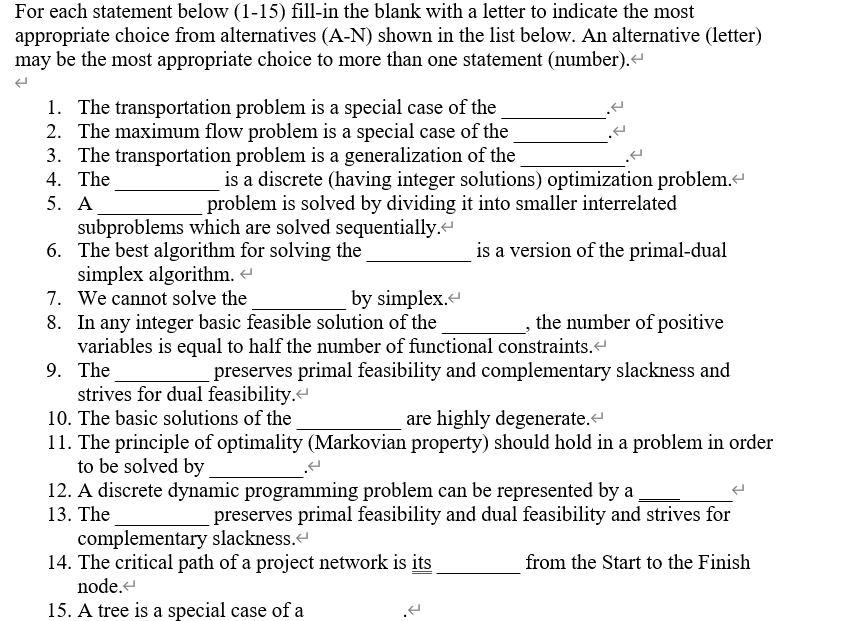
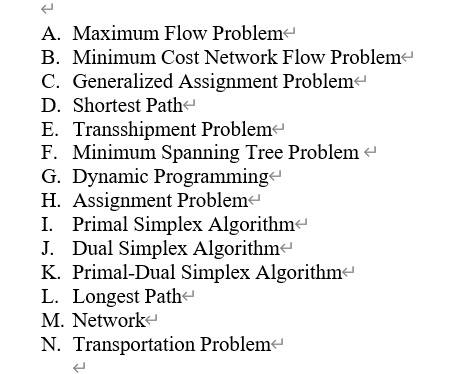
For each statement below (1-15) fill-in the blank with a letter to indicate the most appropriate choice from alternatives (A-N) shown in the list below. An alternative (letter) may be the most appropriate choice to more than one statement (number). 1. The transportation problem is a special case of the 2. The maximum flow problem is a special case of the 3. The transportation problem is a generalization of the 4. The is a discrete (having integer solutions) optimization problem. 5. A problem is solved by dividing it into smaller interrelated subproblems which are solved sequentially. 6. The best algorithm for solving the is a version of the primal-dual simplex algorithm. 7. We cannot solve the by simplex. 8. In any integer basic feasible solution of the the number of positive variables is equal to half the number of functional constraints. 9. The preserves primal feasibility and complementary slackness and strives for dual feasibility. 10. The basic solutions of the are highly degenerate. 11. The principle of optimality (Markovian property) should hold in a problem in order to be solved by 12. A discrete dynamic programming problem can be represented by a 13. The preserves primal feasibility and dual feasibility and strives for complementary slackness. 14. The critical path of a project network is its from the Start to the Finish node. 15. A tree is a special case of a A. Maximum Flow Problem B. Minimum Cost Network Flow Problem C. Generalized Assignment Problem D. Shortest Path E. Transshipment Problem F. Minimum Spanning Tree Problem - G. Dynamic Programming H. Assignment Problem I. Primal Simplex Algorithm J. Dual Simplex Algorithm K. Primal-Dual Simplex Algorithm L. Longest Path M. Network N. Transportation Problem For each statement below (1-15) fill-in the blank with a letter to indicate the most appropriate choice from alternatives (A-N) shown in the list below. An alternative (letter) may be the most appropriate choice to more than one statement (number). 1. The transportation problem is a special case of the 2. The maximum flow problem is a special case of the 3. The transportation problem is a generalization of the 4. The is a discrete (having integer solutions) optimization problem. 5. A problem is solved by dividing it into smaller interrelated subproblems which are solved sequentially. 6. The best algorithm for solving the is a version of the primal-dual simplex algorithm. 7. We cannot solve the by simplex. 8. In any integer basic feasible solution of the the number of positive variables is equal to half the number of functional constraints. 9. The preserves primal feasibility and complementary slackness and strives for dual feasibility. 10. The basic solutions of the are highly degenerate. 11. The principle of optimality (Markovian property) should hold in a problem in order to be solved by 12. A discrete dynamic programming problem can be represented by a 13. The preserves primal feasibility and dual feasibility and strives for complementary slackness. 14. The critical path of a project network is its from the Start to the Finish node. 15. A tree is a special case of a A. Maximum Flow Problem B. Minimum Cost Network Flow Problem C. Generalized Assignment Problem D. Shortest Path E. Transshipment Problem F. Minimum Spanning Tree Problem - G. Dynamic Programming H. Assignment Problem I. Primal Simplex Algorithm J. Dual Simplex Algorithm K. Primal-Dual Simplex Algorithm L. Longest Path M. Network N. Transportation

Step by Step Solution

There are 3 Steps involved in it

1 Expert Approved Answer
Step: 1 Unlock blur-text-image

Question Has Been Solved by an Expert!

Get step-by-step solutions from verified subject matter experts

Step: 2 Unlock
Step: 3 Unlock

Students Have Also Explored These Related General Management Questions!