







Question: 2. For labour cost in the lab: a. Compute a labour rate variance and a labour efficiency variance. (Do not round intermediate calculations, Round Effliciency
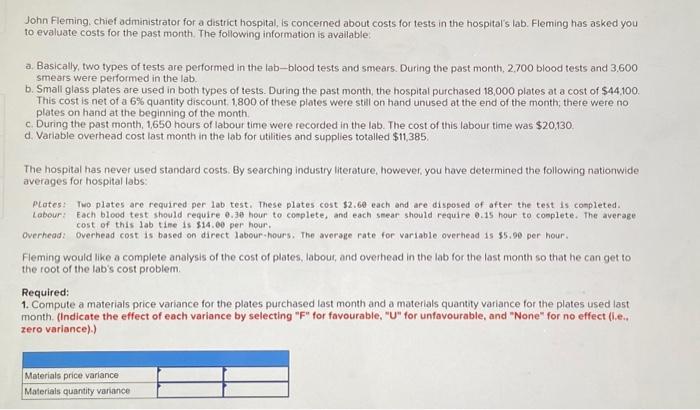
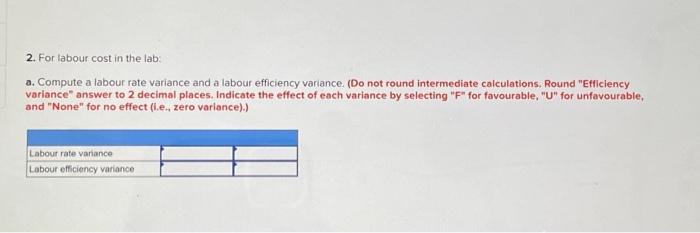
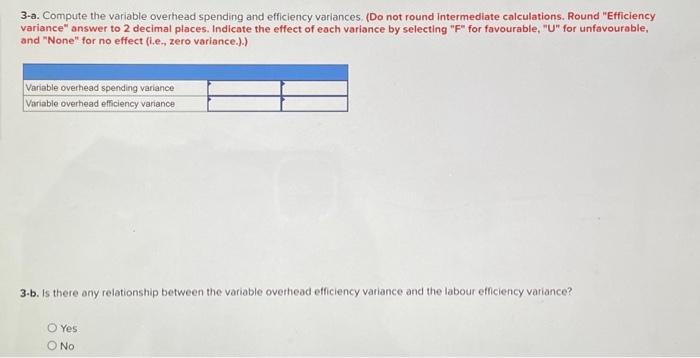
2. For labour cost in the lab: a. Compute a labour rate variance and a labour efficiency variance. (Do not round intermediate calculations, Round "Effliciency variance" answer to 2 decimal places. Indicate the effect of each variance by selecting "F" for favourable, "U" for unfavourable, and "None" for no effect (lie., zero variance).) 3-a. Compute the variable overhead spending and efficiency variances, (Do not round Intermediate calculations. Round "Efficiency variance" answer to 2 decimal places. Indicate the effect of eoch variance by selecting "F" for favourable, "U" for unfavourable, and "None" for no effect (i.e., zero variance.).) 3.b. Is there any relationship between the variable overhead efficiency variance and the labour efficiency variance? Yes No John Fleming. chief administrator for a district hospital, is concerned about costs for tests in the hospital's lab. Fleming has asked you to evaluate costs for the past month. The following information is avallable: a. Basically, two types of tests are performed in the lab-blood tests and smears. During the past month, 2.700 blood tests and 3.600 smears were performed in the lab. b. Small glass plates are used in both types of tests. During the past month, the hospital purchased 18,000 plates at a cost of $44,100. This cost is net of a 6% quantity discount. 1,800 of these plates were stal on hand unused at the end of the month; there were no plates on hand at the beginning of the month. c. During the past month, 1,650 hours of labour time were recorded in the lab. The cost of this labour time was $20,130. d. Variable overhead cost last month in the lab for utilities and supplies totalled \$11,385. The hospital has never used standard costs. By searching industry literature, however, you have determined the following nationwide averages for hospital labs: Plotes: Two plates are required per lab test. These plates cost $2.60 each and are disposed of after the test is conpleted. Labour: Each blood test should require 0.30 hour to cooplete, and each smear should require 0.15 hour to cooplete. The average cost of this lab time is $14.60 per hour. Overhead: Overhead cost is based on direct labour-hours. The avorage rate for variable overhead is 35.90 per hour. Fleming would like a complete analysis of the cost of plates, labout, and overhead in the lab for the last month so that he can get to the foot of the lab's cost problem. Required: 1. Compute a materials price variance for the plates purchased last month and a materials quantity variance for the plates used last month. (Indicate the effect of each variance by selecting "F" for favourable, "U" for unfavourable, and "None" for no effect (I.e., zero variance).)
Step by Step Solution
There are 3 Steps involved in it

Get step-by-step solutions from verified subject matter experts
 Study Help