





Question: 2. For this problem we use the finite model presented in Exercise 3 (Section 3.7, page 53) of the text, with r = 0. (For
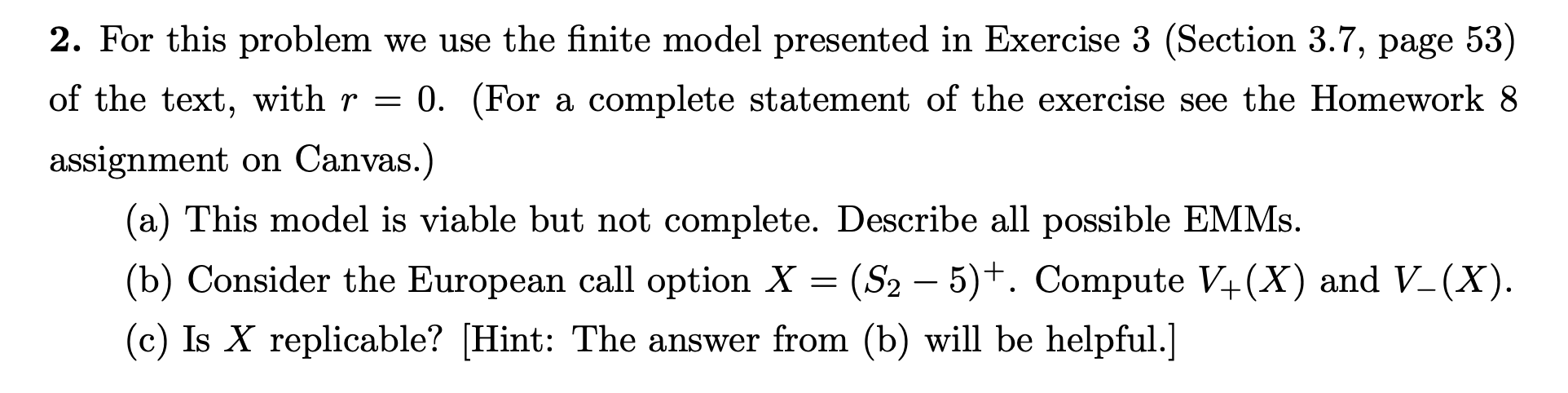
2. For this problem we use the finite model2. For this problem we use the finite model
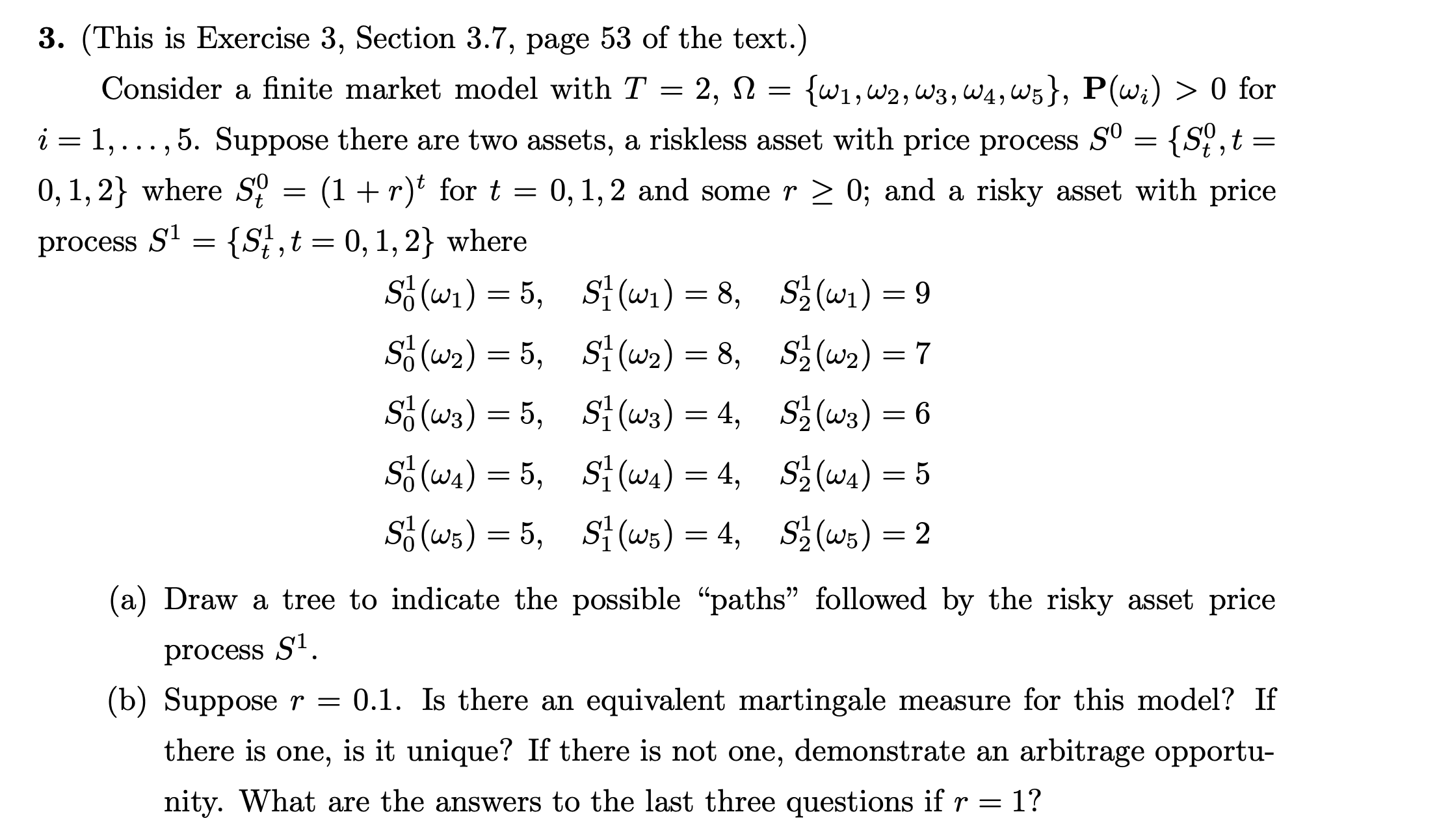
2. For this problem we use the finite model presented in Exercise 3 (Section 3.7, page 53) of the text, with r = 0. (For a complete statement of the exercise see the Homework 8 assignment on Canvas.) (a) This model is viable but not complete. Describe all possible EMMs. (b) Consider the European call option X = (S2 5)*. Compute V;(X) and V_(X). (c) Is X replicable? [Hint: The answer from (b) will be helpful.] 3. (This is Exercise 3, Section 3.7, page 53 of the text.) Consider a finite market model with T = 2, 0 = {w1, W2, w3, WA, w5}, P(wi) > 0 for i = 1,...,5. Suppose there are two assets, a riskless asset with price process SO = {S!, t = 0, 1, 2} where S? = (1 + r) for t = 0, 1, 2 and some r 2 0; and a risky asset with price process S1 = {SI, t = 0, 1, 2} where So ( w1 ) = 5, S1 ( w1 ) = 8 , $2 ( w 1 ) = 9 So ( W2 ) = 5 , S1 ( W 2 ) = 8 , S2 ( W 2 ) = 7 So ( W3 ) = 5 , S1 ( W3 ) = 4 , S2 ( W 3 ) = 6 So ( WA ) = 5, SI (WA ) = 4 , S2 ( WA ) = 5 So (W5 ) = 5, S1 (w5 ) = 4 , S2 ( w5 ) = 2 (a Draw a tree to indicate the possible "paths" followed by the risky asset price process Si. (b) Suppose r = 0.1. Is there an equivalent martingale measure for this model? If there is one, is it unique? If there is not one, demonstrate an arbitrage opportu nity. What are the answers to the last three questions if r = 1

Step by Step Solution

There are 3 Steps involved in it

1 Expert Approved Answer
Step: 1 Unlock blur-text-image

Question Has Been Solved by an Expert!

Get step-by-step solutions from verified subject matter experts

Step: 2 Unlock
Step: 3 Unlock

Students Have Also Explored These Related Accounting Questions!