





Question: 2. Given a graph G = (V. E) a matching is a subset of edges in G that do not intersect. More formally A/ C
2. Given a graph G = (V. E) a matching is a
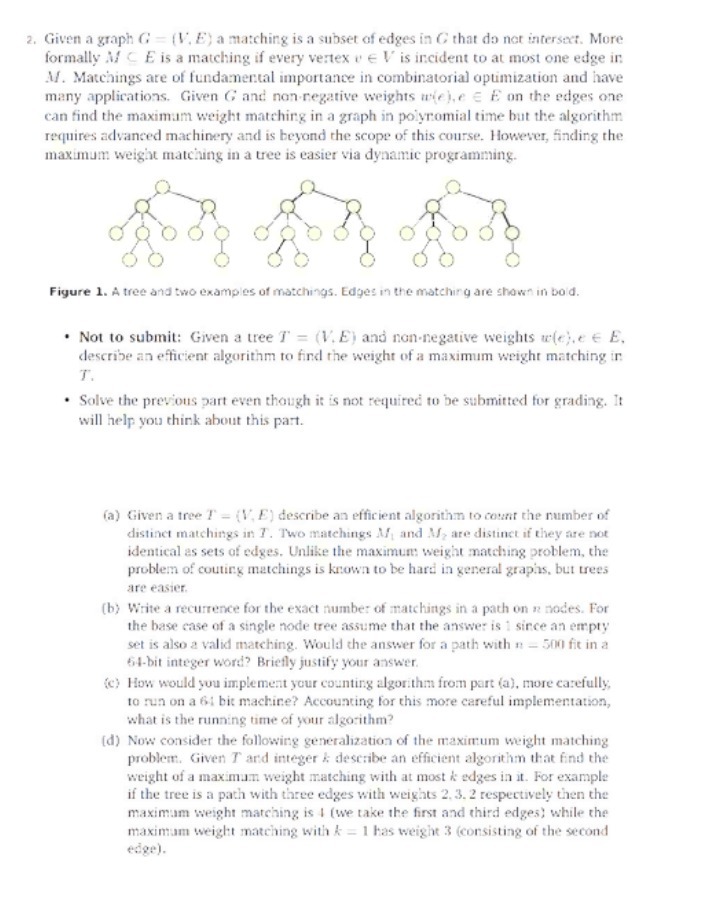
2. Given a graph G = (V. E) a matching is a subset of edges in G that do not intersect. More formally A/ C E is a matching if every vertex e e V is incident to at most one edge in M. Matchings are of fundamental importance in combinatorial optimization and have many applications. Given G and non negative weights me),e e E on the edges one can find the maximum weight matching in a graph in polynomial time but the algorithm requires advanced machinery and is beyond the scope of this course. However, finding the maximum weight matching in a tree is easier via dynamic programming. Figure 1. A tree and two examples of matchings. Edges in the matching are shown in bod. . Not to submit: Given a tree T' = (V. E) and non-negative weights (chee E. describe an efficient algorithm to find the weight of a maximum weight matching in T. . Solve the previous part even though it is not required to be submitted for grading. It will help you think about this part. (a) Given a tree T = (V, E) describe an efficient algorithm to count the number of distinct matchings in F. Two matchings A, and My are distinct if they are not identical as sets of edges. Unlike the maximum weight matching problem, the problem of couting matchings is known to be hard in general graphs, but trees are easier. (b) Write a recurrence for the exact number of matchings in a path on a nodes. For the base case of a single node tree assume that the answer is 1 since an empty set is also a valid matching. Would the answer for a path with n - 500 fit in a 64-bit integer word? Briefly justify your answer. (c) How would you implement your counting algorithm from part (a), more carefully, to run on a 64 bit machine? Accounting for this more careful implementation, what is the running time of your algorithm? [d) Now consider the following generalization of the maximum weight matching problem. Given T and integer & describe an efficient algorithm that find the weight of a maximum weight matching with at most & edges in it. For example if the tree is a path with three edges with weights 2. 3. 2 respectively then the maximum weight matching is I (we take the first and third edges) while the maximum weight matching with A = 1 has weight 3 (consisting of the second edge)

Step by Step Solution

There are 3 Steps involved in it

1 Expert Approved Answer
Step: 1 Unlock blur-text-image

Question Has Been Solved by an Expert!

Get step-by-step solutions from verified subject matter experts

Step: 2 Unlock
Step: 3 Unlock

Students Have Also Explored These Related Mathematics Questions!