







Question: 2) Given the relation R and the following functional dependencies, answer the following questions. R(A, B, C, D) Note: All attibutes contain only atomic values.
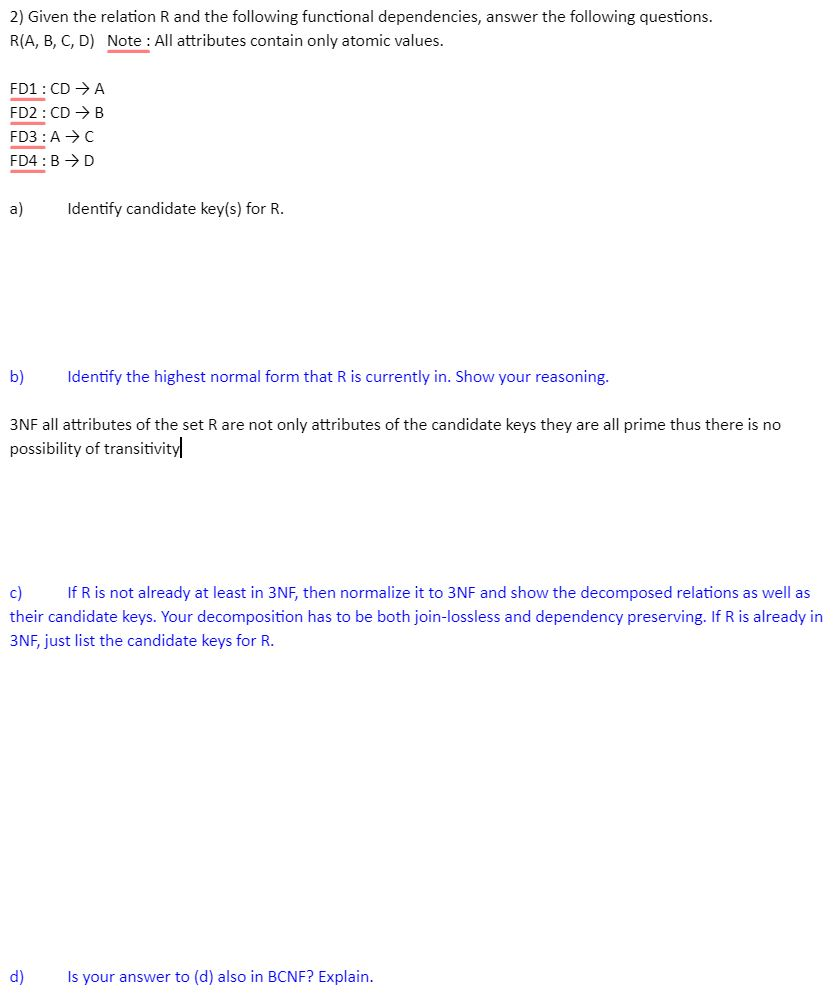
2) Given the relation R and the following functional dependencies, answer the following questions. R(A, B, C, D) Note: All attibutes contain only atomic values. FD1 CDA FD2 : CD B 3: A C FD4: BD a) Identify candidate key(s) for R. b) dentify the highest normal form that R is currently in. Show your reasoning. 3NF all attributes of the set R are not only attributes of the candidate keys they are all prime thus there is no possibility of transitivityl c) If R is not already at least in 3NF, then normalize it to 3NF and show the decomposed relations as well as their candidate keys. Your decomposition has to be both join-lossless and dependency preserving. If R is already in 3NF, just list the candidate keys for R. d) your answer to (d) also in BCNF? Explain
Step by Step Solution
There are 3 Steps involved in it

Get step-by-step solutions from verified subject matter experts
 Study Help