







Question: 2. Heat and work are the same in which they are a property but they differ in their sign convention. 3. There are three modes
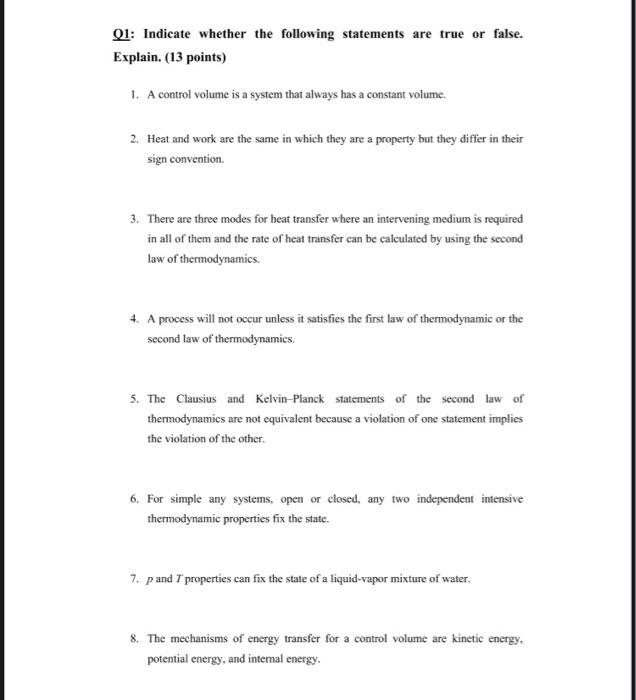
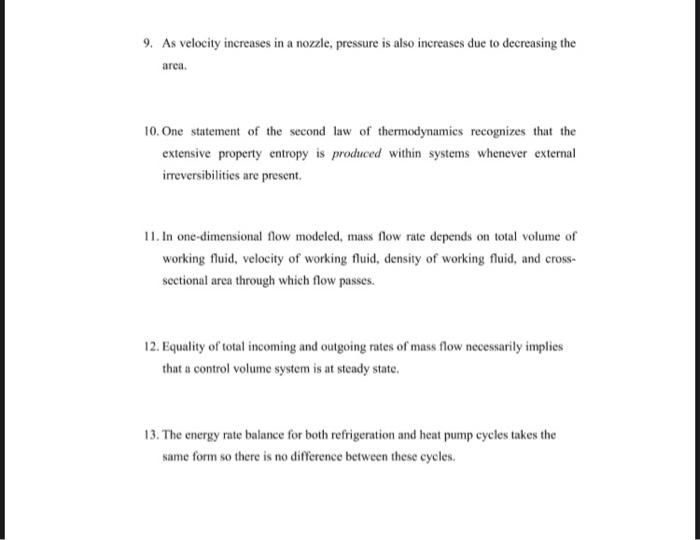
2. Heat and work are the same in which they are a property but they differ in their sign convention. 3. There are three modes for heat transfer where an intervening medium is required in all of them and the rate of heat transfer can be calculated by using the second law of thermodynamics. 4. A process will not occur unless it satisfies the first law of thermodynamic or the second law of thermodynamics. 5. The Clausius and Kelvin-Planck statements of the second law of thermodynamics are not equivalent because a violation of one statement implies the violation of the other. 6. For simple any systems, open or closed, any two independent intensive thermodynamic properties fix the state. 7. p and T properties can fix the state of a liquid-vapor mixture of water. 8. The mechanisms of energy transfer for a control volume are kinetic energy, potential energy, and internal energy. 9. As velocity inereases in a nozzle, pressure is also inereases due to decreasing the area. 10. One statement of the second law of thermodynamics recognizes that the extensive property entropy is produced within systems whenever external irreversibilitics are present. 11. In one-dimensional flow modeled, mass flow rate depends on total volume of working fluid, velocity of working fluid, density of working fluid, and crosssectional area through which flow passes. 12. Equality of total incoming and outgoing rates of mass flow necessarily implies that a control volume system is at steady state. 13. The energy rate balance for both refrigeration and heat pump cycles takes the same form so there is no difference between these cycles
Step by Step Solution
There are 3 Steps involved in it

Get step-by-step solutions from verified subject matter experts
 Study Help