







Question: 2. Identify relevant stakeholders and present one stakeholder's view. >> TOMS SHOES: ETHICALLY GLOBAL? The focus of most of the chapters in this text has
2. Identify relevant stakeholders and present one stakeholder's view. 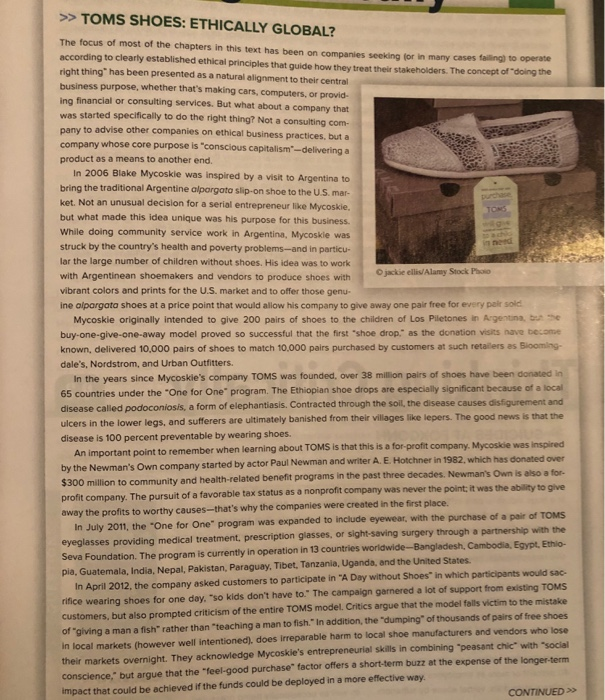
>> TOMS SHOES: ETHICALLY GLOBAL? The focus of most of the chapters in this text has been on companies seeking for in many cases fong to operate according to clearly established ethical principles that guide how they treat the stakeholders. The concept of doing the right thing has been presented as a natural alignment to their central business purpose, whether that's making cars, computers, or provid- ing financial or consulting services. But what about a company that was started specifically to do the right thing? Not a consulting com- pany to advise other companies on ethical business practices, but a company whose core purpose is "conscious capitalism-delivering a product as a means to another end. In 2006 Blake Mycoskie was inspired by a visit to Argentina to bring the traditional Argentine alpargato slip-on shoe to the U.S. mar- ket. Not an unusual decision for a serial entrepreneur like Mycoskie, but what made this idea unique was his purpose for this business. While doing community service work in Argentina, Mycoskle was struck by the country's health and poverty problems and in particu lar the large number of children without shoes. His idea was to work with Argentinean shoemakers and vendors to produce shoes with jackie ellis/Alamy Stock Photo vibrant colors and prints for the U.S. market and to offer those genu. ine alpargata shoes at a price point that would allow his company to give away one pair free for every pairs Mycoskie originally intended to give 200 pairs of shoes to the children of Los Piletones in Argentina, buse buy-one-give-one-away model proved so successful that the first shoe drop," as the donation visits have become known, delivered 10,000 pairs of shoes to match 10,000 pairs purchased by customers at such retailers as Slooming dale's, Nordstrom, and Urban Outfitters. In the years since Mycoskle's company TOMS was founded, over 38 million pairs of shoes have been donated in 65 countries under the "One for One" program. The Ethiopian shoe drops are especially significant because of a local disease called podoconiosis, a form of elephantiasis. Contracted through the soil, the disease causes disfigurement and ulcers in the lower legs, and sufferers are ultimately banished from their villages like lepers. The good news is that the disease is 100 percent preventable by wearing shoes. An important point to remember when learning about TOMS is that this is a for-profit company. Mycoskie was inspired by the Newman's Own company started by actor Paul Newman and writer A. E. Hotchner in 1982 which has donated over $300 million to community and health-related benefit programs in the past three decades. Newman's Own is also a for- profit company. The pursuit of a favorable tax status as a nonprofit company was never the point, it was the ability to give away the profits to worthy causes-that's why the companies were created in the first place. In July 2011, the "One for One" program was expanded to include eyewear, with the purchase of a pair of TOMS eyeglasses providing medical treatment prescription glasses, or sight-saving surgery through a partnership with the Seva Foundation. The program is currently in operation in 13 countries worldwide-Bangladesh, Cambodia, Egypt, Ethio- pia, Guatemala, India, Nepal, Pakistan, Paraguay, Tibet. Tanzania, Uganda, and the United States In April 2012, the company asked customers to participate in "A Day without Shoes in which participants would sac rifice wearing shoes for one day, so kids don't have to." The campaign garnered a lot of support from existing TOMS customers, but also prompted criticism of the entire TOMS model. Critics argue that the model falls victim to the mistake of giving a man a fish" rather than "teaching a man to fish. In addition, the "dumping of thousands of pairs of free shoes in local markets (however well intentioned), does irreparable harm to local shoe manufacturers and vendors who lose their markets overnight. They acknowledge Mycoskie's entrepreneurial skills in combining "peasant chic with "social conscience." but argue that the feel-good purchase" factor offers a short-term buzz at the expense of the longer-term impact that could be achieved if the funds could be deployed in a more effective way CONTINUED >> to help celebrate the company's ninth anniversary in May 2015, Mycoskie used Instagram to underline the companys I model by donating a pair of shoes for every Instagram photo of hare feet posted with the hashtag #withoutshoes. ter companies, such as eyewear vender Warby Parker have taken a different approach to the B1G1 model. Rather man simply giving eyeglasses away, the company covers the cost of training parts, and manufacture for a second pair or glasses through social venture partners such as Vision Spring which then employ sales agents (9,000 in 13 countries to give basic eye exams and sell eyeglasses at affordable prices in their local communities. The premise is that supporang a sales network reduces the likelihood of making communities dependent upon handouts, or situations where donations were made to children who already had eyeglasses or shoes. TOMS, meanwhile, has taken some steps to address criticism of its "dumping" model, where shoes manufactured in China are given away in Africa, by supporting local manufacturing options to ensure that residents receive shoes that are best suited to their local climate. This, in turn, provides employment in addition to free footwear
Step by Step Solution
There are 3 Steps involved in it
1 Expert Approved Answer
Step: 1 Unlock

Question Has Been Solved by an Expert!
Get step-by-step solutions from verified subject matter experts
Step: 2 Unlock
Step: 3 Unlock
 Study Help