







Question: (2). If f(x) is defined at 3, then lingf (x) exists. 1-+3 (3). If both limf(x) and f(3) exist, then f (x) is continuous at
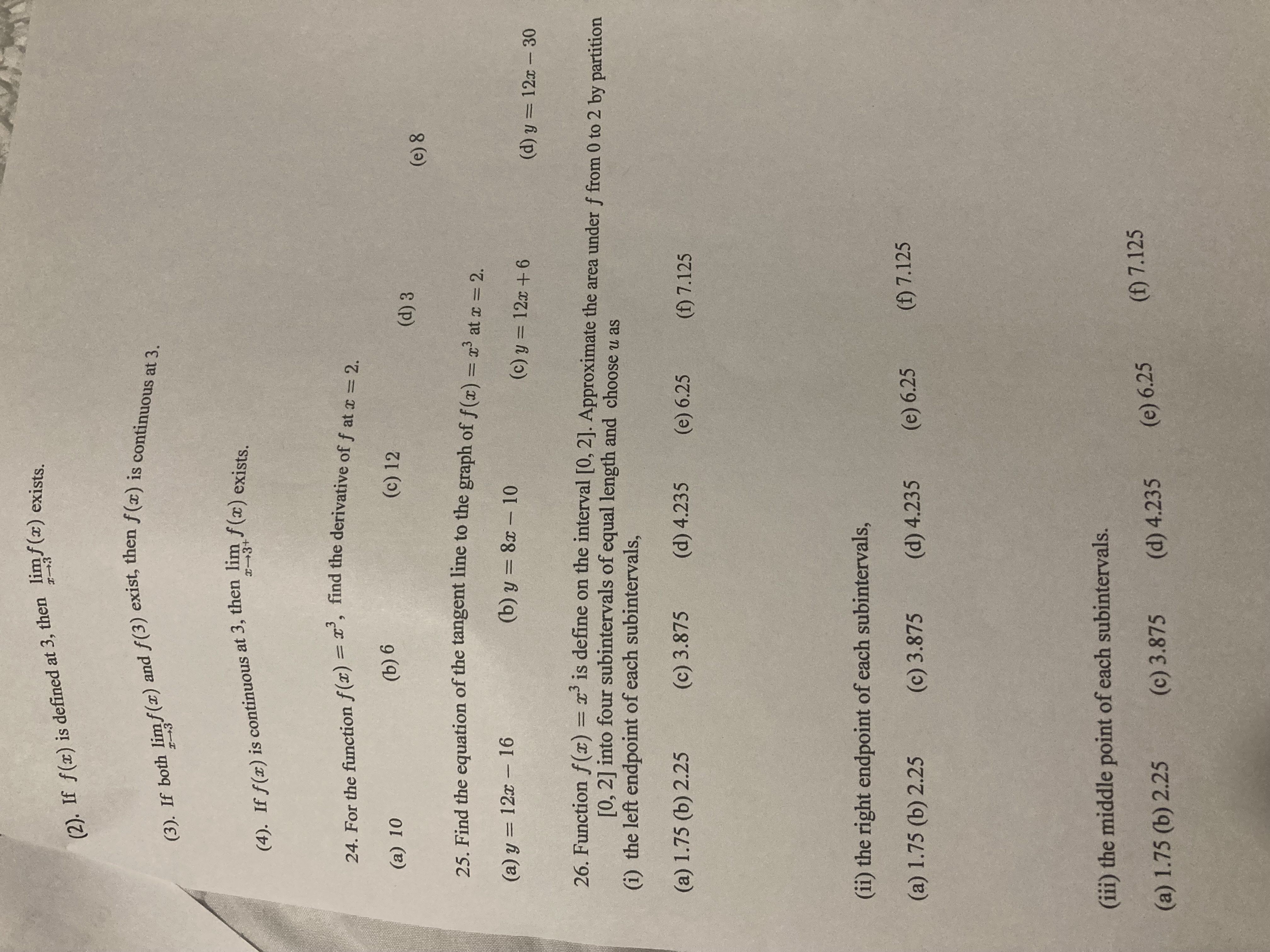
(2). If f(x) is defined at 3, then lingf (x) exists. 1-+3 (3). If both limf(x) and f(3) exist, then f (x) is continuous at 3. (4). If f(x) is continuous at 3, then lim f(x) exists. 24. For the function f(x) = ', find the derivative of f at x = 2. (a) 10 ( b ) 6 (c) 12 (d) 3 (e) 8 25. Find the equation of the tangent line to the graph of f (x) = x3 at x = 2. (a)y = 12x - 16 (b)y = 8x - 10 (c) y = 12x + 6 (d) y = 12x - 30 26. Function f(x) = ' is define on the interval [0, 2]. Approximate the area under f from 0 to 2 by partition [0, 2] into four subintervals of equal length and choose u as (i) the left endpoint of each subintervals, (a) 1.75 (b) 2.25 (c) 3.875 (d) 4.235 (e) 6.25 (f) 7.125 (ii) the right endpoint of each subintervals, (a) 1.75 (b) 2.25 (c) 3.875 (d) 4.235 (e) 6.25 (f) 7.125 (iii) the middle point of each subintervals. (a) 1.75 (b) 2.25 (c) 3.875 (d) 4.235 (e) 6.25 (f) 7.125
Step by Step Solution
There are 3 Steps involved in it

Get step-by-step solutions from verified subject matter experts
 Study Help