







Question: 2. In class we solved the quantum harmonic oscillator problem for a diatomic molecule. As part of that solution we transformed coordinates from x, the
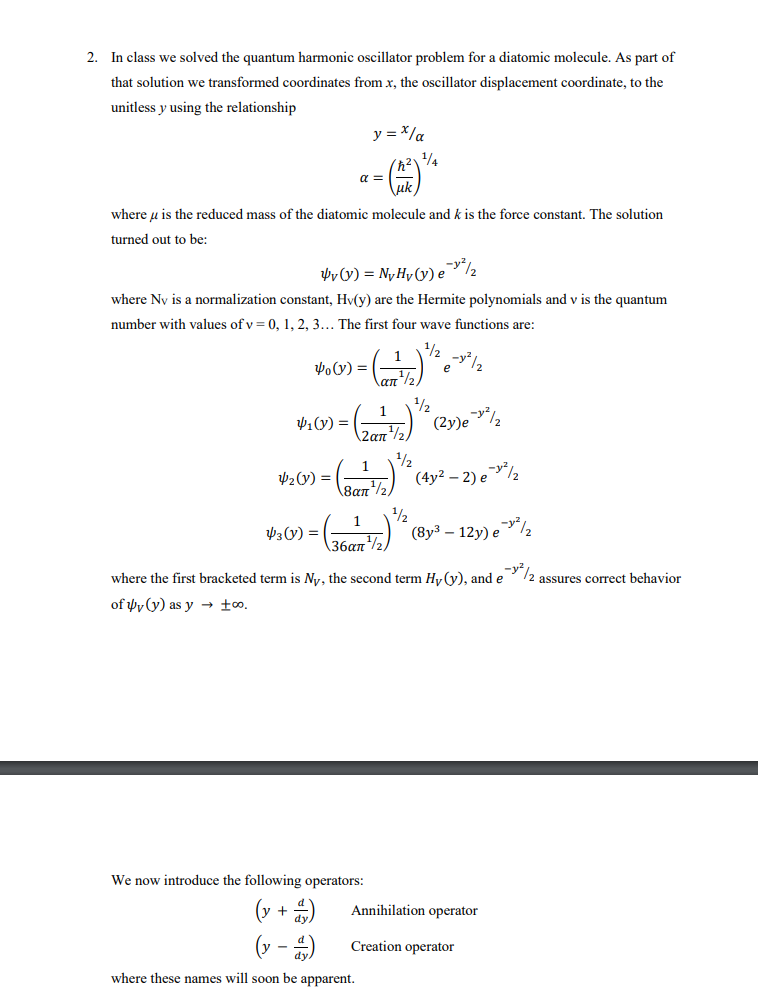
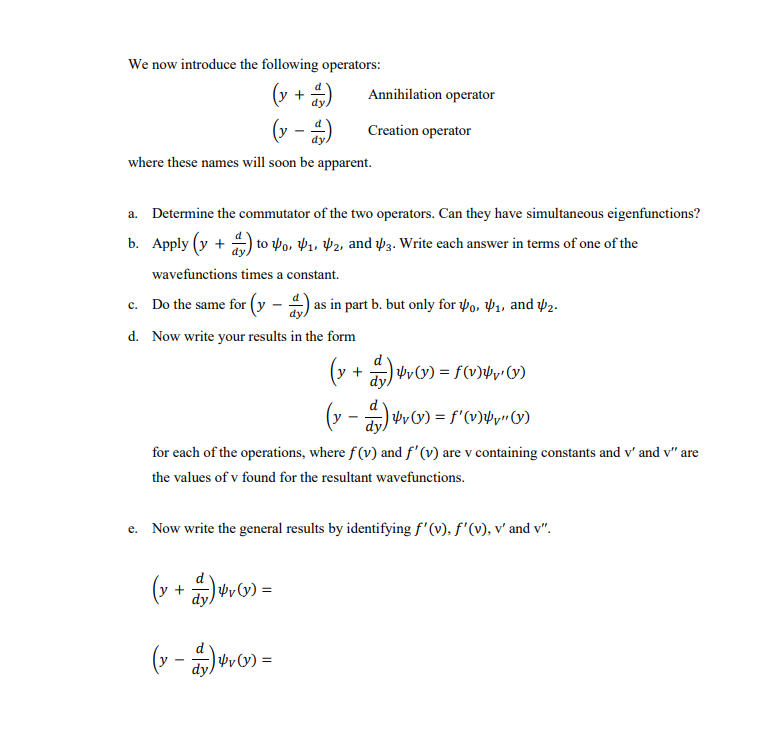
2. In class we solved the quantum harmonic oscillator problem for a diatomic molecule. As part of that solution we transformed coordinates from x, the oscillator displacement coordinate, to the unitless y using the relationship y = */a 1/4 = uk where u is the reduced mass of the diatomic molecule and k is the force constant. The solution turned out to be: Wv y) = Ny Hyby) e -1/2 where Ny is a normalization constant, Hv(y) are the Hermite polynomials and v is the quantum number with values of v=0, 1, 2, 3... The first four wave functions are: 1/2 W.(y) = lan / -Y* 12 e 1 16y) = 1/2 (2ye 6-7/ 2an 1 1/2 42(y) = 8an"/2) (4y2 2) e-/2 1 1/2 23(y) = (8y3 12y) e 2/2 (36an 1/2 where the first bracketed term is Ny, the second term Hy(y), and e 6-7/ assures correct behavior of y(y) as y to. We now introduce the following operators: Annihilation operator (y + b ) (y - ) Creation operator where these names will soon be apparent. We now introduce the following operators: (y + m ) Annihilation operator (y - y) Creation operator where these names will soon be apparent. a. Determine the commutator of the two operators. Can they have simultaneous eigenfunctions? b. Apply (y + ) to Yo, 41, 42, and 3. Write each answer in terms of one of the wavefunctions times a constant. c. Do the same for (v - ) as in part b. but only for 40, 41, and 42- d. Now write your results in the form (v + ) *v(y) = f(vwv) .s#v a 4v) fv)(y (v - ) *v%) = f'(W)#v" () ) y for each of the operations, where f (v) and f'(v) are v containing constants and v' and v" are the values of v found for the resultant wavefunctions. e. Now write the general results by identifying f'(v), f'(v), v' and v". (+)) = (v - ay) 400) = Wvy
Step by Step Solution
There are 3 Steps involved in it

Get step-by-step solutions from verified subject matter experts
 Study Help