







Question: ( (2) In lecture 1(e), we looked at the problem of minimizing the weight of a cantilever beam subject to the constraint that the deflection
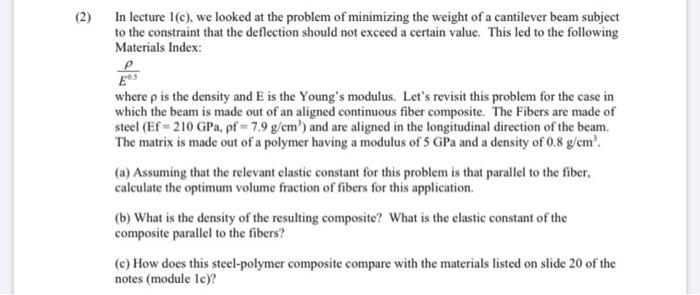
( (2) In lecture 1(e), we looked at the problem of minimizing the weight of a cantilever beam subject to the constraint that the deflection should not exceed a certain value. This led to the following Materials Index: P where p is the density and E is the Young's modulus. Let's revisit this problem for the case in which the beam is made out of an aligned continuous fiber composite. The Fibers are made of steel (Ef = 210 GPa, pf = 7.9 g/cm') and are aligned in the longitudinal direction of the beam. The matrix is made out of a polymer having a modulus of 5 GPa and a density of 0.8 g/cm (a) Assuming that the relevant elastic constant for this problem is that parallel to the fiber, calculate the optimum volume fraction of fibers for this application (b) What is the density of the resulting composite? What is the elastic constant of the composite parallel to the fibers? (c) How does this steel-polymer composite compare with the materials listed on slide 20 of the notes (module 1c)? ( (2) In lecture 1(e), we looked at the problem of minimizing the weight of a cantilever beam subject to the constraint that the deflection should not exceed a certain value. This led to the following Materials Index: P where p is the density and E is the Young's modulus. Let's revisit this problem for the case in which the beam is made out of an aligned continuous fiber composite. The Fibers are made of steel (Ef = 210 GPa, pf = 7.9 g/cm') and are aligned in the longitudinal direction of the beam. The matrix is made out of a polymer having a modulus of 5 GPa and a density of 0.8 g/cm (a) Assuming that the relevant elastic constant for this problem is that parallel to the fiber, calculate the optimum volume fraction of fibers for this application (b) What is the density of the resulting composite? What is the elastic constant of the composite parallel to the fibers? (c) How does this steel-polymer composite compare with the materials listed on slide 20 of the notes (module 1c)
Step by Step Solution
There are 3 Steps involved in it

Get step-by-step solutions from verified subject matter experts
 Study Help