


Question: 2. In problem one, the assumption is the revalued against the rupee as indicated in the problem, and that the euro and the move together,
2. In problem one, the assumption is the revalued against the rupee as indicated in the problem, and that the euro and the move together, in lockstep, in terms of the ER. Presuppose additionally, we know the euro and the $ revalue against the rupee by what is indicated in problem one, and the and euro continue to appreciate against the rupee for the next 20 years. Before we presupposed the sales to Europe do not alter due to the rupee depreciation. However, now we make a huge change in the assumptions. How would the results of problem one alterif we assume that, as a result of the rupee depreciation, sales from India to Europe rise intertemporally for 20 years. Furthermore, presuppose the sensitivity of demand is high for the Indian product in Europe (how European customers see it.) Elaborate on the possible altered effect of the NPV of the Indian investment . Note the only geographical areas involved are India, Europe and the US. Treat Europe and the US as one entity. There is NO OTHER COUNTRY If we assume that sales from India to Europe rise inter temporally for 20 years, the results of problem one would alter significantly. The NPV of the Indian investment would increase significantly, as the company would be able to sell more products at a higher price. Additionally, the price elasticity of demand would have a significant impact on the NPV of the investment, as a higher price elasticity would lead to a higher NPV. Please answer one full page of word doc 2. In problem one, the assumption is the revalued against the rupee

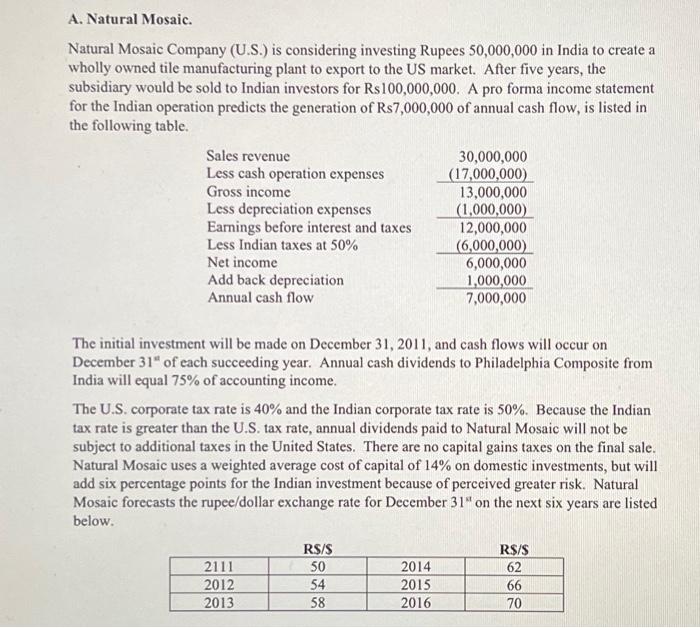
A. Natural Mosaic. Natural Mosaic Company (U.S.) is considering investing Rupees 50,000,000 in India to create a wholly owned tile manufacturing plant to export to the US market. After five years, the subsidiary would be sold to Indian investors for Rs 100,000,000. A pro forma income statement for the Indian operation predicts the generation of Rs7,000,000 of annual cash flow, is listed in the following table. The initial investment will be made on December 31,2011, and cash flows will occur on December 31" of each succeeding year. Annual cash dividends to Philadelphia Composite from India will equal 75% of accounting income. The U.S. corporate tax rate is 40% and the Indian corporate tax rate is 50%. Because the Indian tax rate is greater than the U.S. tax rate, annual dividends paid to Natural Mosaic will not be subject to additional taxes in the United States. There are no capital gains taxes on the final sale. Natural Mosaic uses a weighted average cost of capital of 14% on domestic investments, but will add six percentage points for the Indian investment because of perceived greater risk. Natural Mosaic forecasts the rupee/dollar exchange rate for December 31a on the next six years are listed below

Step by Step Solution

There are 3 Steps involved in it

1 Expert Approved Answer
Step: 1 Unlock blur-text-image
Question Has Been Solved by an Expert!

Get step-by-step solutions from verified subject matter experts

Step: 2 Unlock
Step: 3 Unlock

Students Have Also Explored These Related Accounting Questions!