







Question: 2. In the previous question the semicircular wavelets were all traveling the same speed as they made up a new wavefront. However, waves often travel
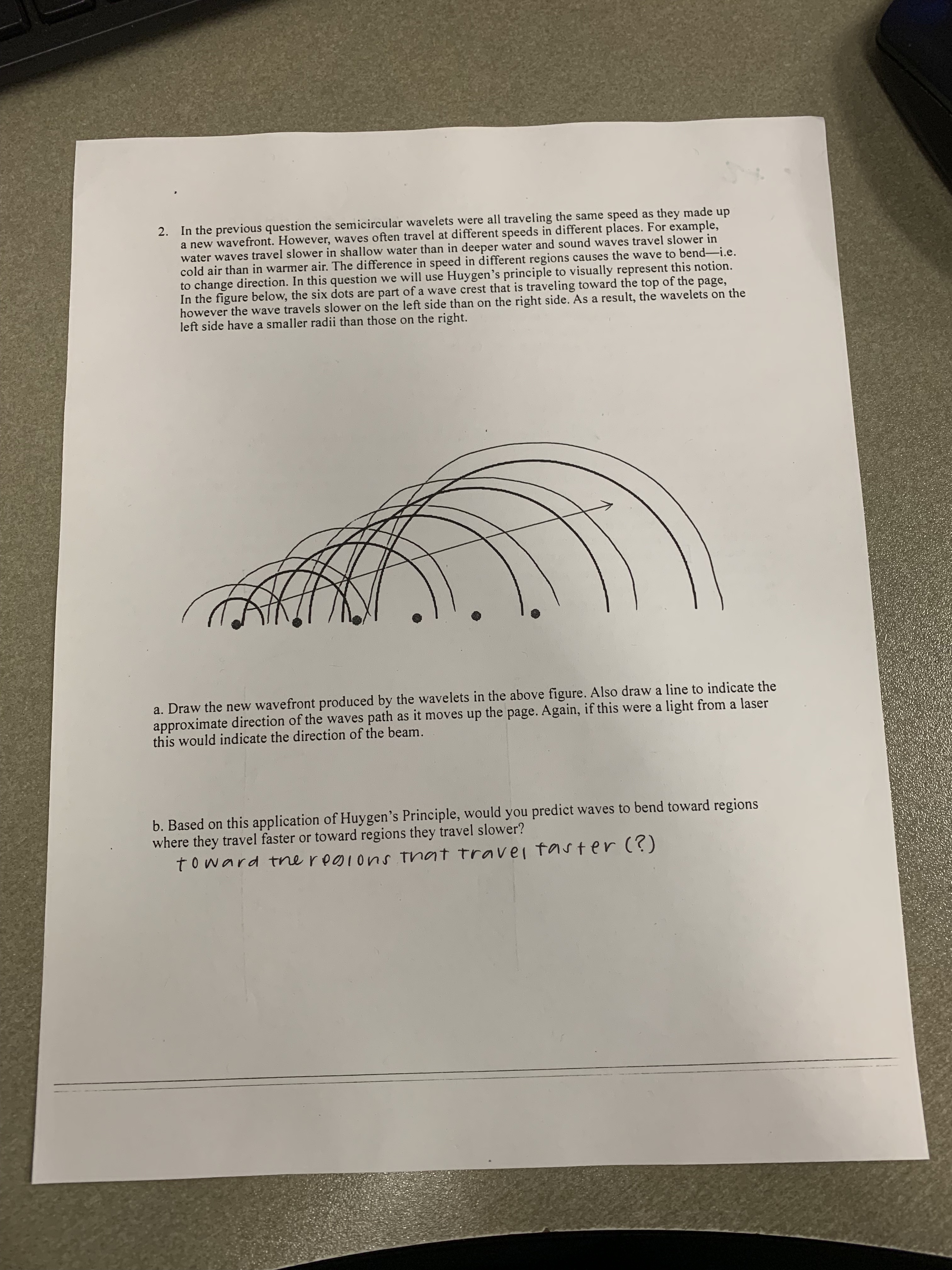
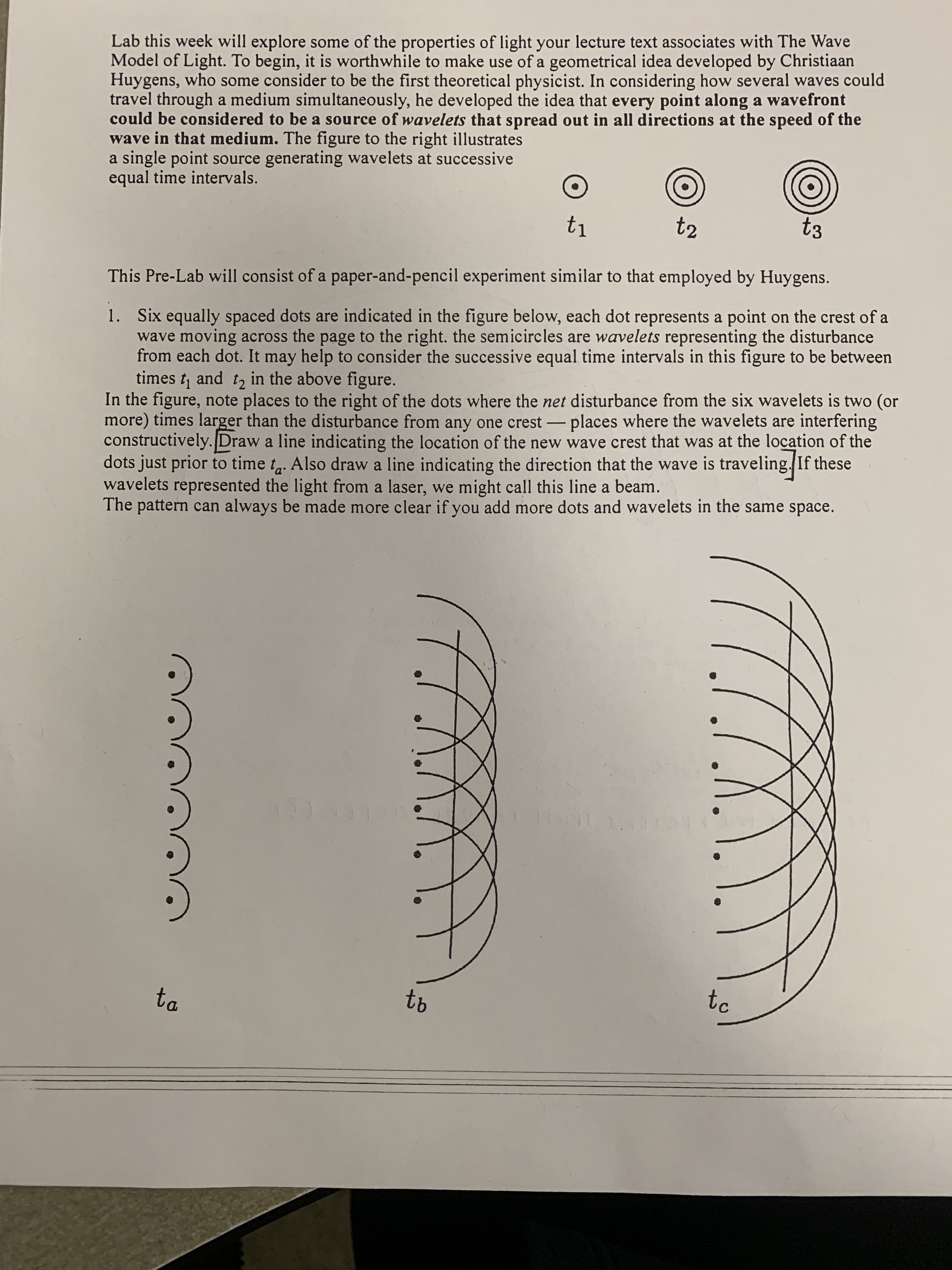
2. In the previous question the semicircular wavelets were all traveling the same speed as they made up a new wavefront. However, waves often travel at different speeds in different places. For example, water waves travel slower in shallow water than in deeper water and sound waves travel slower in cold air than in warmer air. The difference in speed in different regions causes the wave to bend-i.e. to change direction. In this question we will use Huygen's principle to visually represent this notion In the figure below, the six dots are part of a wave crest that is traveling toward the top of the page, however the wave travels slower on the left side than on the right side. As a result, the wavelets on the left side have a smaller radii than those on the right. a. Draw the new wavefront produced by the wavelets in the above figure. Also draw a line to indicate the approximate direction of the waves path as it moves up the page. Again, if this were a light from a laser this would indicate the direction of the beam. b. Based on this application of Huygen's Principle, would you predict waves to bend toward regions where they travel faster or toward regions they travel slower? toward the regions that travel faster (? )Lab this week will explore some of the properties of light your lecture text associates with The Wave Model of Light. To begin, it is worthwhile to make use of a geometrical idea developed by Christiaan Huygens, who some consider to be the first theoretical physicist. In considering how several waves could travel through a medium simultaneously, he developed the idea that every point along a wavefront could be considered to be a source of wavelets that spread out in all directions at the speed of the wave in that medium. The figure to the right illustrates a single point source generating wavelets at successive equal time intervals. O t1 t2 t3 This Pre-Lab will consist of a paper-and-pencil experiment similar to that employed by Huygens. 1 . Six equally spaced dots are indicated in the figure below, each dot represents a point on the crest of a wave moving across the page to the right. the semicircles are wavelets representing the disturbance from each dot. It may help to consider the successive equal time intervals in this figure to be between times t, and to in the above figure. In the figure, note places to the right of the dots where the net disturbance from the six wavelets is two (or more) times larger than the disturbance from any one crest - places where the wavelets are interfering constructively. Draw a line indicating the location of the new wave crest that was at the location of the dots just prior to time ta. Also draw a line indicating the direction that the wave is traveling. If these wavelets represented the light from a laser, we might call this line a beam. The pattern can always be made more clear if you add more dots and wavelets in the same space. ta to to
Step by Step Solution
There are 3 Steps involved in it

Get step-by-step solutions from verified subject matter experts
 Study Help