







Question: 2. Integer Arithmetic 2.(a) Show the steps for adding following two numbers: 67 and-12. Assume we have 10 bits to represer every number. (Hint: first
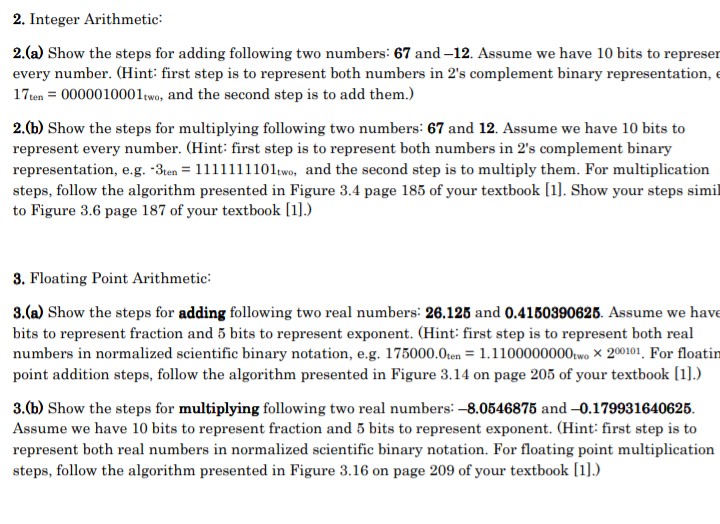
2. Integer Arithmetic 2.(a) Show the steps for adding following two numbers: 67 and-12. Assume we have 10 bits to represer every number. (Hint: first step is to represent both numbers in 2's complement binary representation, e 17,en = 000001000!two, and the second step is to add them.) 2.(b) Show the steps for multiplying following two numbers: 67 and 12. Assume we have 10 bits to represent every number. (Hint: first step is to represent both numbers in 2's complement binary representation, e.g.-3ten-111111110|two, and the second step is to multiply them. For multiplication steps, follow the algorithm presented in Figure 3.4 page 185 of your textbook [1l. Show your steps simil to Figure 3.6 page 187 of your textbook [1]) 3. Floating Point Arithmetic: 3.(a) Show the steps for adding following two real numbers: 26.125 and 0.4150390625. Assume we have bits to represent fraction and 5 bits to represent exponent. (Hint: first step is to represent both real numbers in normalized scientific binary notation, e.g. 175000.0ten-1.11 00000000two 200101, For floatin point addition steps, follow the algorithm presented in Figure 3.14 on page 205 of your textbook [1) 3.(b) Show the steps for multiplying following two real numbers:-8.0546875 and-0.179931640625 Assume we have 10 bits to represent fraction and 5 bits to represent exponent. (Hint: first step is to represent both real numbers in normalized scientific binary notation. For floating point multiplication steps, follow the algorithm presented in Figure 3.16 on page 209 of your textbook [1])
Step by Step Solution
There are 3 Steps involved in it

Get step-by-step solutions from verified subject matter experts
 Study Help